
If your thermostat says 72in degrees but the room feels more like 78in degrees—well, that example doesn't quite work with a temperature, but you get the idea: when the number on the display doesn't match how the room actually feels, something is skewing the sensor's reading. The good news is that a thermostat reading the wrong temperature is rarely a sign the whole unit is dying. Most of the time it comes down to one of three things: where the thermostat is mounted, dirt or drift affecting the sensor, or a wiring/calibration issue that's easy to correct.
This guide walks through each cause in order of how common it is, so you can work through the list quickly instead of guessing.
Start With a Simple Comparison Test
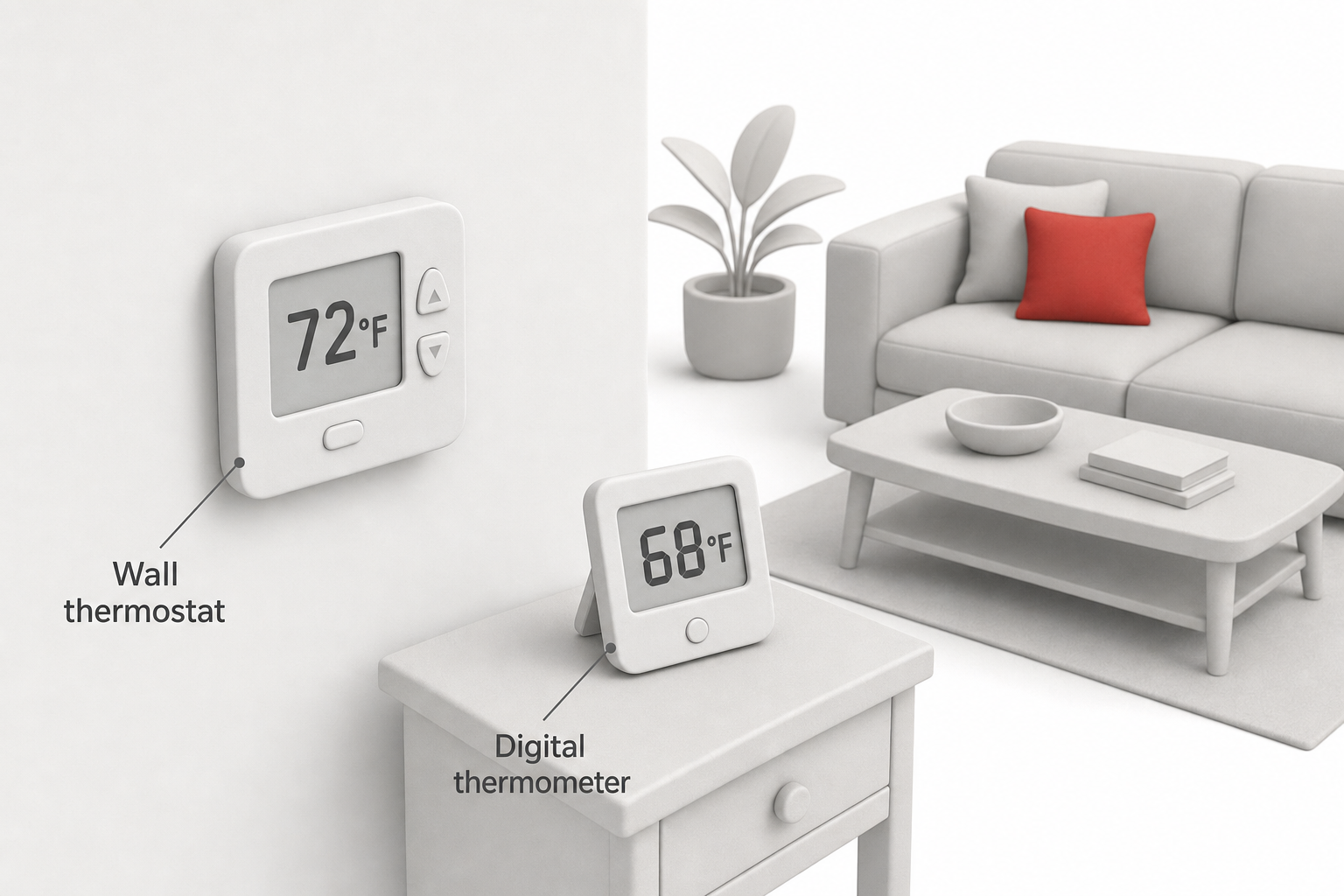
Before assuming the thermostat is broken, confirm there's actually a discrepancy. Buy or borrow a separate digital thermometer (even a basic indoor/outdoor one works) and set it on a shelf or table near the thermostat—not touching it, not in direct sun, at roughly the same height.
Let both readings settle for 15in minutes, then compare. That example again uses the wrong unit—let it settle for 15 minutes (no measurement tag needed here since it's time, not length).
If the two readings are within a degree or two, your thermostat is probably fine and the "wrong" feeling is more about airflow or humidity than an actual sensor error. If they're off by 4°F or more, move on to the causes below.
Cause 1: Poor Thermostat Placement
Placement is the single most common reason a thermostat reads inaccurately, and it's often overlooked because the thermostat has been in the same spot for years.
Problem locations include:
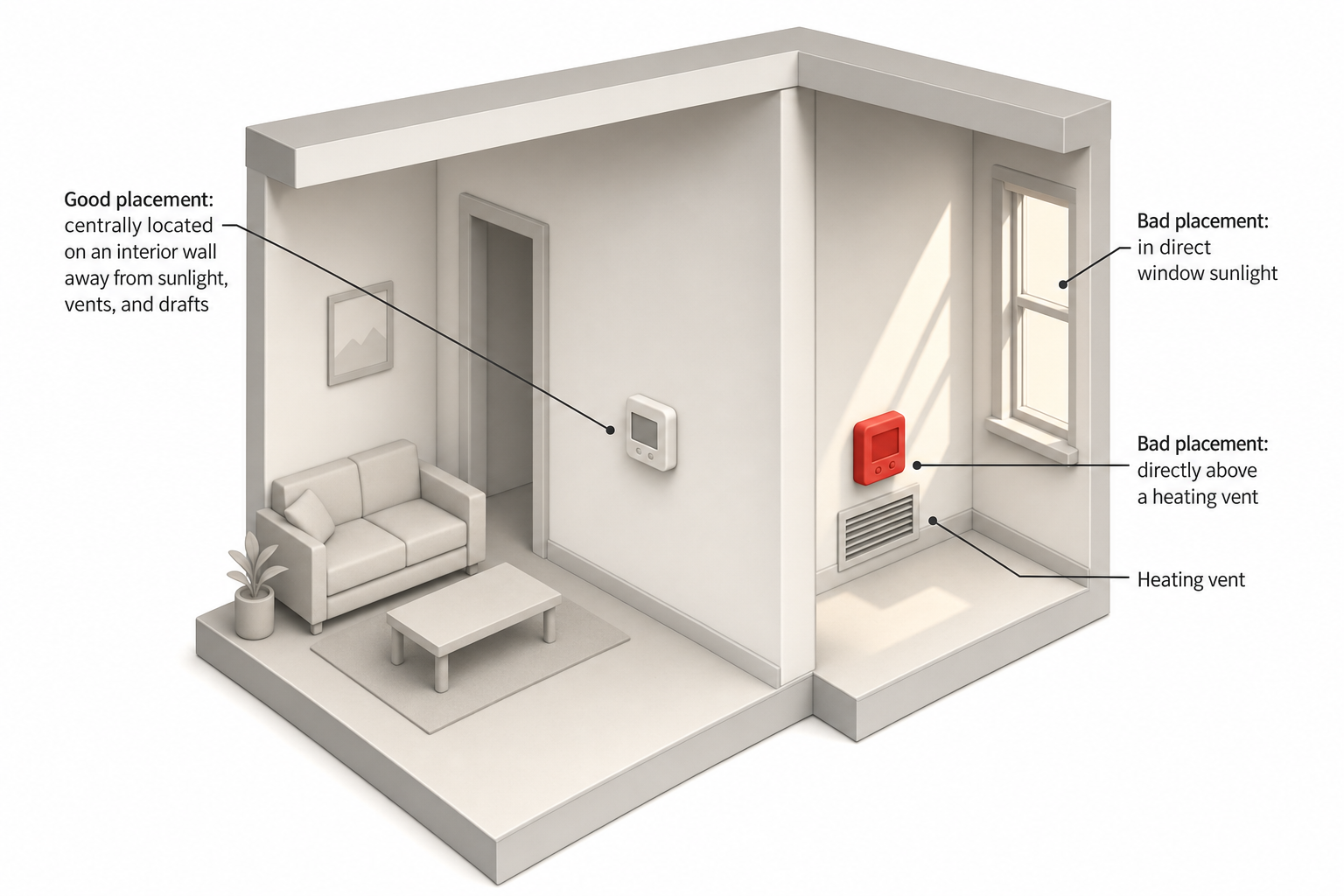
- Direct sunlight. A patch of afternoon sun hitting the thermostat can push its reading several degrees above the actual room temperature, causing the system to run longer than needed or shut off too early.
- Near a supply vent or return grille. Airflow blowing directly on the sensor gives a reading that reflects the duct temperature, not the room.
- On an exterior wall. Exterior walls run cooler in winter and warmer in summer than interior walls, especially if insulation is thin or a stud bay behind the thermostat is poorly sealed.
- Above a heat-generating appliance or electronics. A thermostat mounted above a TV, lamp, or kitchen appliance can pick up radiant heat that has nothing to do with the room's actual comfort level.
- In a hallway or stairwell far from living spaces. These areas often run several degrees different from the rooms people actually spend time in, especially in homes with only one thermostat.
- Near an exterior door. Drafts every time the door opens can cause erratic short-term swings.
Manufacturers typically recommend mounting a thermostat on an interior wall, about 52in to 60in above the floor, away from vents, windows, doorways, and direct sunlight, in a central spot that represents the average conditions in the home.
If your thermostat sits in a bad spot, relocating it is often the single most effective fix—more effective than recalibrating a unit that's simply in the wrong place.
Cause 2: Dust and Dirt Inside the Thermostat
Older mechanical and even some digital thermostats have an internal sensor, and dust buildup around it can insulate the sensor from actual room air, causing it to lag or drift from the true temperature.
To check:
- Turn off the system at the thermostat or breaker before opening the cover.
- Gently remove the faceplate (most snap or unscrew from a wall plate).
- Use a soft brush or a can of compressed air to clear dust from the sensor area and any exposed contacts.
- Avoid touching the sensor element directly or spraying cleaners inside the unit.
- Reattach the cover and restore power.
If your thermostat is more than 15–20 years old and uses a mercury switch or bimetallic coil, dust sensitivity is especially common with that design, and recalibration may only be a temporary fix. At that age, many homeowners find it more cost-effective to consider replacing the unit with a modern digital or smart model, which typically holds calibration far more reliably.
Cause 3: The Sensor Has Drifted Out of Calibration
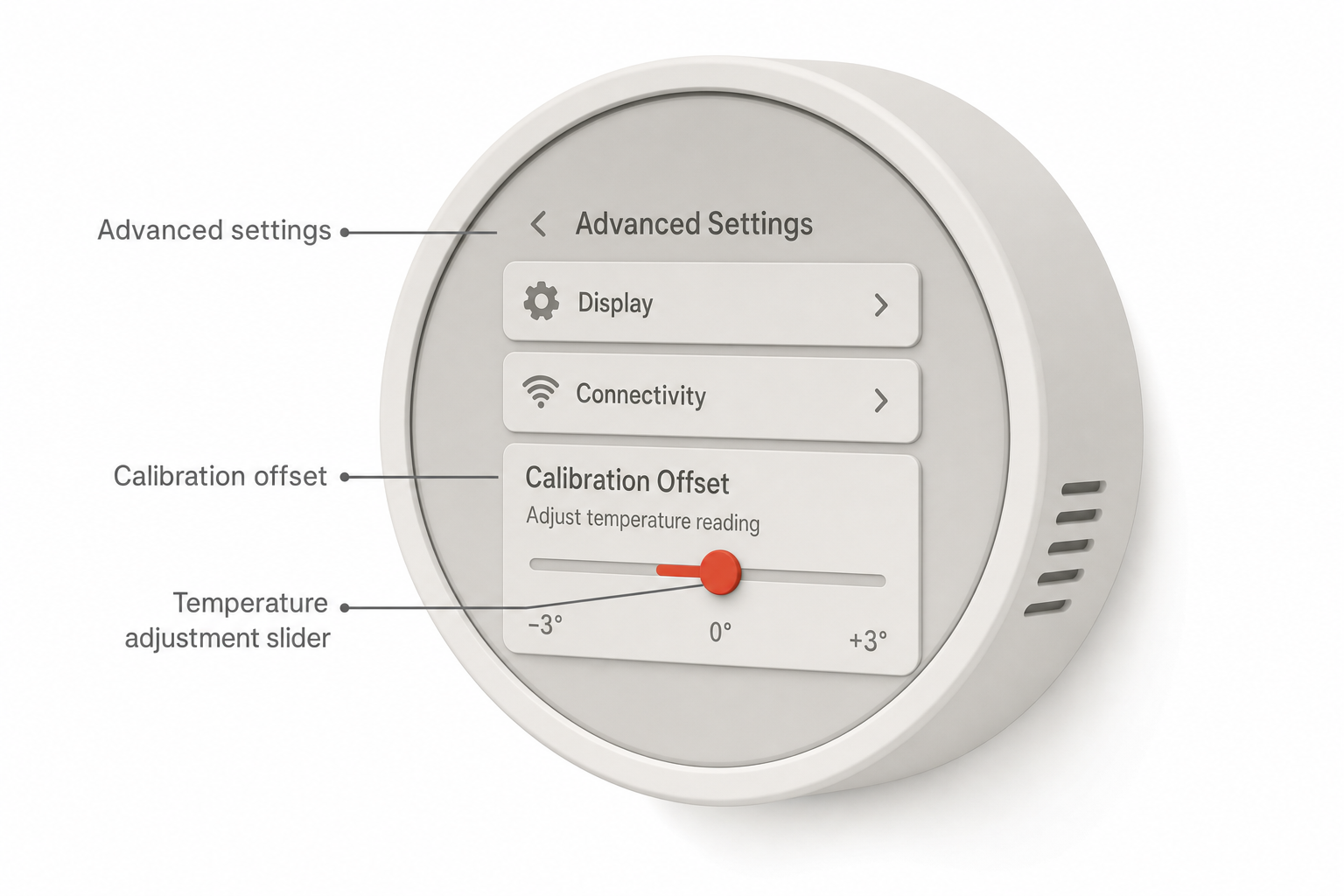
Even well-placed, clean thermostats can drift over time, especially older analog models. Many thermostats include a calibration offset setting that lets you nudge the displayed temperature up or down to match a known-accurate reference thermometer.
To calibrate:
- Confirm the discrepancy using the comparison test described above, ideally averaged over a few readings at different times of day.
- Check the manufacturer's manual for your specific model's calibration menu — on digital and smart thermostats this is usually buried in an installer or advanced settings menu, not the main screen.
- Enter the offset needed to correct the reading (for example, if the thermostat reads 3°F high, you'd typically dial in a -3°F offset).
- Re-test after 30–60 minutes to confirm the adjustment holds.
On older mechanical (dial or lever) thermostats, calibration sometimes involves manually adjusting a small screw or lever near the sensing coil — refer to your specific model's documentation, since the process varies significantly between brands and eras.
Cause 4: Wiring or Sensor Hardware Problems
If placement is fine, the unit is clean, and calibration doesn't hold, the issue may be electrical:
- Loose or corroded wire connections at the thermostat terminals can cause intermittent or inaccurate readings, especially on multi-stage systems with several wire connections.
- A failing remote sensor — many smart thermostats support additional room sensors used to average temperature readings across the home. A dying battery or a sensor placed poorly (same rules as above) can pull the average reading off.
- Compatibility issues between a newer smart thermostat and older HVAC equipment can sometimes cause erratic cycling that feels like a bad reading but is actually a control signal mismatch.
- A failing thermistor (the actual temperature-sensing component) is less common but does happen, particularly in units that have been exposed to moisture or extreme temperature swings.
If you suspect wiring problems, turn off power to the system at the breaker before removing the thermostat from its wall plate to visually inspect connections. Look for wires that aren't fully seated in their terminals, or greenish corrosion on the terminal screws.
When to Call a Professional
Consider bringing in a licensed HVAC technician if:
- The reading is off even after relocating, cleaning, and calibrating the thermostat.
- You notice short-cycling (the system turning on and off in rapid bursts) alongside the bad reading.
- Wiring at the furnace or air handler looks damaged, corroded, or unlabeled after a previous repair.
- The system is old enough that a technician might recommend a broader inspection rather than treating the thermostat in isolation.
A technician can also check duct static pressure and airflow balance, since uneven airflow between rooms sometimes gets misdiagnosed as a "bad thermostat" when the real issue is duct design.
FAQ
Why does my thermostat say one temperature but the room feels different? This is usually caused by placement — sunlight, drafts, or proximity to a vent — rather than a broken sensor. Try the comparison test above before assuming hardware failure.
Can I recalibrate a thermostat myself? Yes, most digital and smart thermostats have a calibration or offset menu accessible without tools. Check your model's manual, since the exact menu path and range of adjustment vary by brand.
How often should a thermostat be recalibrated? There's no fixed schedule recommended universally; recalibrate whenever you confirm a discrepancy with a separate thermometer, or after moving the thermostat to a new location.
Is a thermostat reading wrong temperature a sign I need a new HVAC system? Not usually. It's far more often a thermostat placement, dirt, or calibration issue than a sign the furnace or air conditioner itself is failing.
Should I replace an old mechanical thermostat instead of recalibrating it? If it's a decades-old mercury-switch or bimetallic-coil model that drifts repeatedly, many homeowners find a modern digital or smart thermostat holds accuracy more reliably and is worth the switch — see the recommendations below for compatible options.