
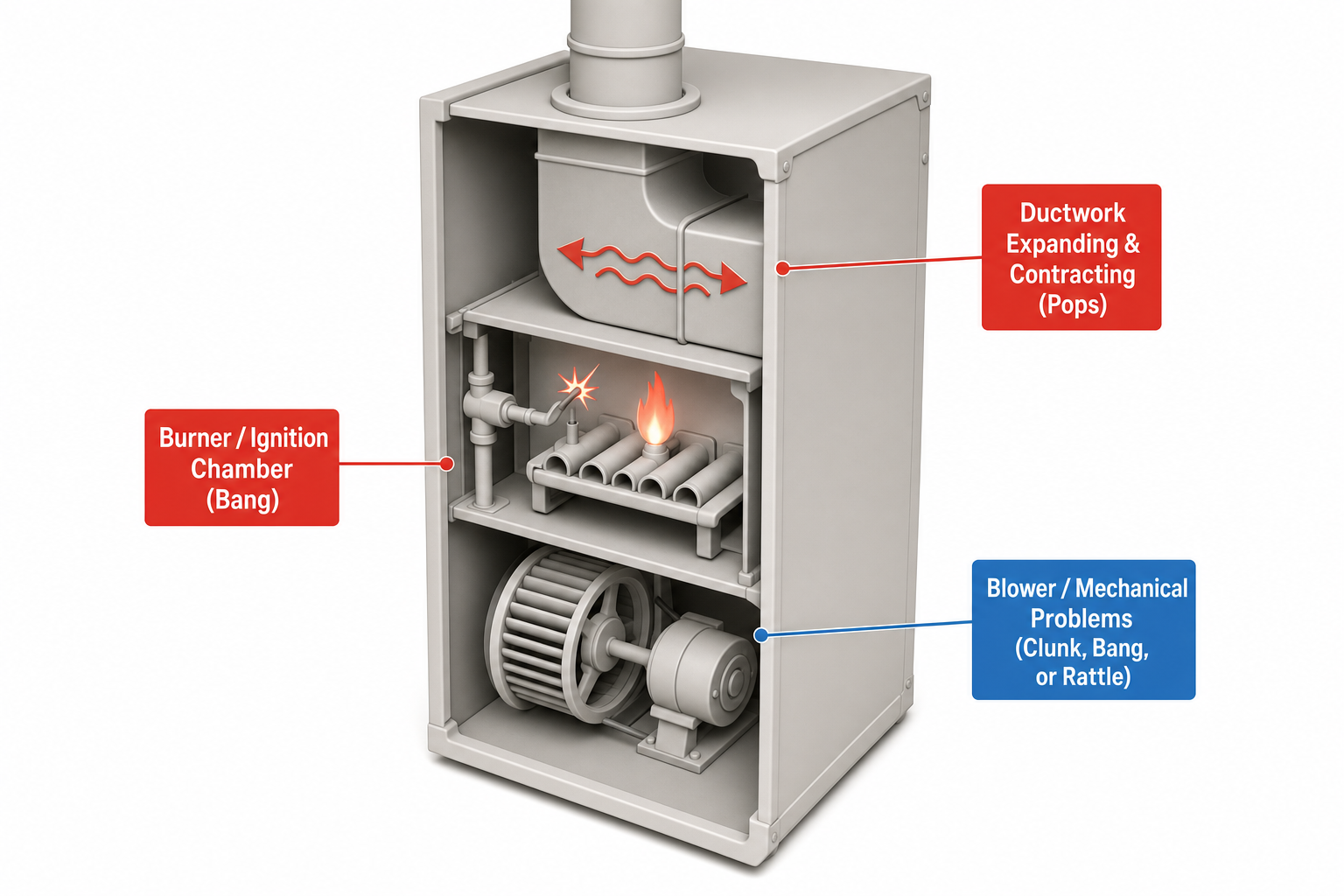
A single loud bang from your furnace when it kicks on — or a series of pops as it runs — is one of the more alarming sounds a home can make. Most of the time it's not catastrophic, but a few causes do warrant caution. This guide walks through the three most common culprits: delayed gas ignition, ductwork expanding and contracting, and blower or mechanical problems, plus how to tell them apart and what to do about each.
First, Identify the Type of Bang
The timing and location of the noise tells you almost everything:
- A single loud boom right when the furnace starts (during ignition) — almost always delayed ignition (a small gas explosion in the burner chamber).
- A series of pops, ticks, or oil-canning "bang" sounds after the burners light or after the system shuts off — usually ductwork expanding or contracting with temperature changes.
- A metallic bang, clang, or thud coming from inside the furnace cabinet itself, especially near the blower — often a mechanical or blower-related issue.
- Rattling or banging that happens continuously while running — loose panels, a failing motor mount, or a bent blower wheel.
Cause 1: Delayed Ignition
This is the most common reason for a loud bang specifically at furnace startup, and it's worth understanding because it's also the cause most linked to safety concerns.
In a properly working gas furnace, the burners ignite within a second or two of gas being released, producing a smooth "whoosh" as the flame spreads evenly. When ignition is delayed, gas continues to flow and pool in the burner chamber for a few extra seconds before it finally lights. That excess gas ignites all at once, causing a small, contained explosion — the bang you hear. Over time, repeated delayed ignition can stress the heat exchanger and, in some cases, crack it.
Common causes of delayed ignition:
- Dirty or corroded burners with clogged ports, causing uneven or weak flame spread
- A dirty or misaligned flame sensor or ignitor (spark or hot-surface type) that fires late
- Low gas pressure at the burner, sometimes from a partially closed shutoff valve
- Cracked or dirty burner orifices restricting gas flow unevenly
- A dirty air filter or blocked intake restricting the air-to-gas mixture
What you can safely check yourself:
- Turn off power to the furnace at the switch or breaker.
- Replace or clean the air filter if it's visibly dirty — restricted airflow can throw off combustion.
- Visually inspect the burner assembly (usually accessible by removing a front panel) for a heavy buildup of dust, rust flakes, or discoloration. Light surface dust can often be brushed off gently with a soft brush; heavier corrosion or rust means the burners likely need professional cleaning or replacement.
- Check that the manual gas shutoff valve near the furnace is fully open (handle parallel to the pipe, not perpendicular).
A technician diagnosing delayed ignition will typically test gas pressure with a manometer, inspect and clean or replace the ignitor and flame sensor, clean or replace burners, and run a combustion analysis to confirm the heat exchanger hasn't been damaged.
Cause 2: Ductwork Expansion and Contraction
If the banging sounds like a series of pops or a single deep "oil-canning" thump coming from the ducts rather than the furnace cabinet — and especially if it happens a minute or two after the burners light, or right after the blower shuts off — sheet metal ductwork is the likely source.
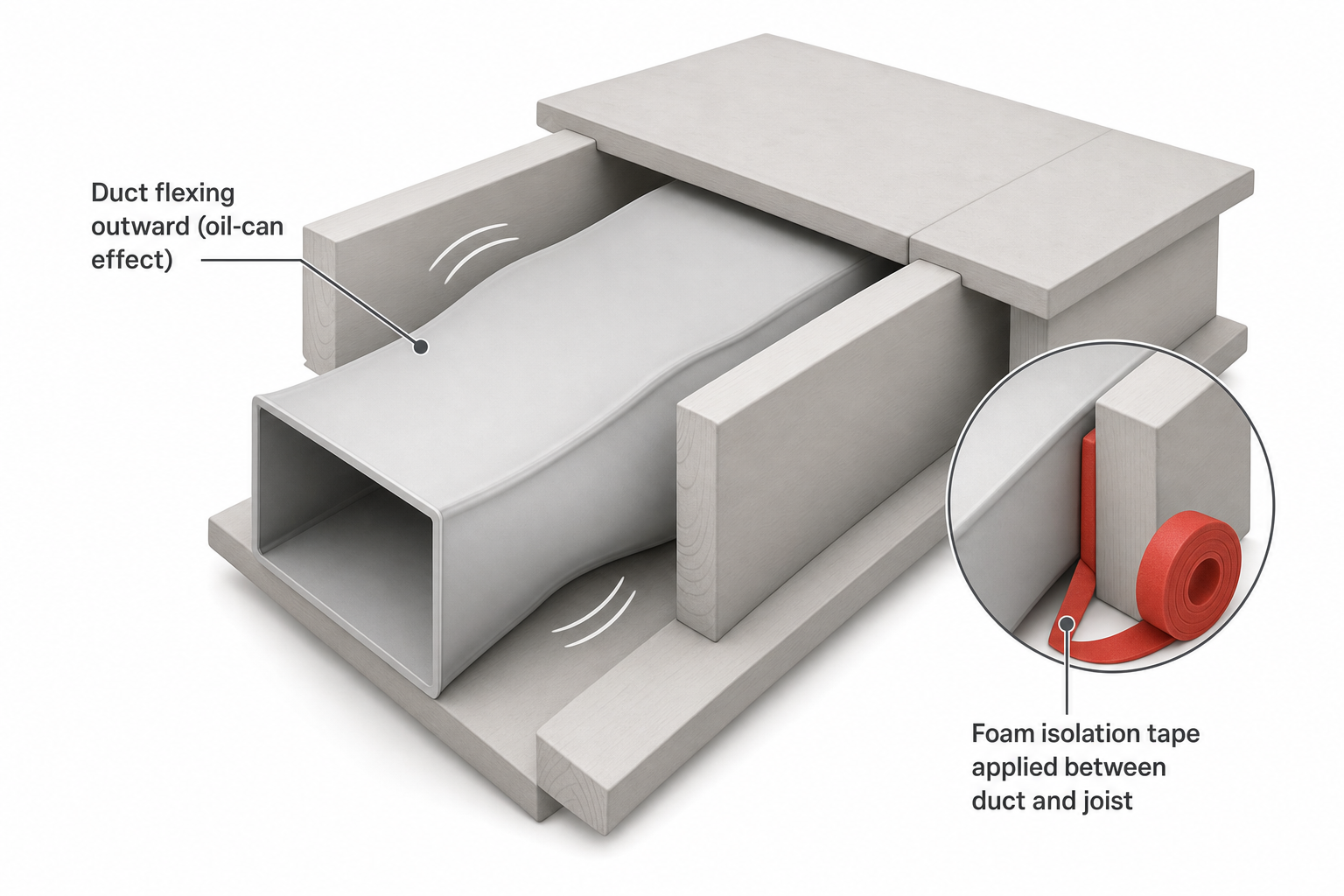
Sheet metal ducts expand slightly as hot air rushes through them and contract as they cool. On long, flat duct runs (especially rectangular trunk lines), this expansion can cause the metal to flex, and if a section pops from concave to convex (like the bottom of a metal oil can), it makes an audible bang. This is a nuisance noise, not a safety issue, though it can be worth addressing if it's happening every single cycle.
Common contributing factors:
- Long, unsupported flat sections of ductwork that flex under pressure changes
- Ducts that fit too tightly against framing, floor joists, or drywall, transferring the bang into the structure
- A blower fan running at too high a speed or airflow that's too aggressive for the duct sizing
- Recently installed or resized ductwork that hasn't been fully secured or cross-broken (a technique where sheet metal is creased to stiffen it against flexing)
What homeowners can do:
- Walk the accessible duct runs (basement, attic, or crawlspace) while the furnace is running and listen/feel for the specific section that's flexing.
- Check for spots where ductwork touches joists, studs, or subfloor without any cushioning — a small strip of adhesive-backed foam or rubber isolation tape between the duct and framing can quiet contact-transmitted bangs.
- Confirm duct hangers and straps aren't loose, allowing the duct to shift and slap against nearby surfaces.
For ducts that flex significantly, a sheet metal contractor can add cross-breaks (stiffening creases), install additional bracing, or in some cases resize a run if airflow is genuinely too high for the duct's dimensions. If the noise coincides with the blower ramping to full speed, a technician can also check whether the blower speed setting is higher than necessary for your ductwork and system size.
Cause 3: Blower and Mechanical Issues
If the bang is metallic, clunky, or sounds like it's coming from inside the furnace cabinet rather than the ducts — especially if it repeats or worsens over several cycles — the blower assembly or another moving part is a likely cause.
Common mechanical causes:
- Loose blower wheel: the set screw holding the squirrel-cage fan to the motor shaft can loosen over time, letting the wheel wobble and strike the housing.
- Bent blower wheel blade: a single bent fin will thump rhythmically once per rotation.
- Failing or worn motor bearings: produce a grinding or banging sound that often gets louder as the motor spins up or down.
- Loose panels or access doors: panels not fully latched can vibrate and bang against the cabinet, especially when the blower motor engages.
- Debris in the blower housing: a screw, bit of insulation, or other object rattling around inside the housing.
- Loose ductwork connections at the plenum: where ducts meet the furnace, screws or straps can work loose and let metal panels bang against each other.
What you can safely check:
- Turn off power to the furnace at the switch and, if comfortable, at the breaker as well.
- Make sure all access panels are fully seated and any safety interlock switches are engaged — a loose panel is genuinely one of the most common causes of banging and rattling, and it's free to fix.
- If you're comfortable removing the blower access panel, visually check for obvious debris in the blower compartment and remove it with the power off.
- Look at the blower wheel for visible wobble once power is restored and the unit runs (from a safe distance, without reaching in) — a wheel that visibly rocks side to side rather than spinning true suggests a loose set screw or bent blade.
A technician can re-tighten or replace a blower wheel, balance or replace a bent wheel, replace worn motor bearings (or the motor itself if bearings aren't serviceable), and re-secure any loose plenum connections.
When to Call a Professional Right Away
Call an HVAC technician promptly, and don't run the furnace in the meantime, if:
- You hear a loud bang at every single startup, not just occasionally
- You smell gas, rotten eggs, or an unusual burning odor
- You notice soot around the furnace, or the burner flame looks yellow/orange instead of blue
- Anyone in the home has symptoms of carbon monoxide exposure (headache, dizziness, nausea) — leave the house and call emergency services or your gas utility immediately in this case, not just an HVAC contractor
- The banging is accompanied by grinding, burning smells from the blower motor, or visible smoke
FAQ
Is a furnace banging noise dangerous? It can be, depending on the cause. A single loud bang at startup (delayed ignition) is worth having inspected promptly since repeated instances can potentially damage the heat exchanger over time. Duct expansion noises are usually just annoying, not dangerous. Any noise paired with a gas smell or burning odor should be treated as a safety issue immediately.
Why does my furnace bang only when it first turns on? A bang specifically at startup, before the blower engages, points strongly toward delayed gas ignition — gas builds up for a moment before catching, causing a small ignition explosion. This is worth having a technician check, especially if it happens consistently.
Can I fix duct banging noises myself? Simple fixes like adding foam padding where ducts contact framing, or re-securing a loose hanger you can see and reach, are reasonable DIY tasks. Adding structural cross-breaks to stiffen a flexing duct run, or resizing ductwork, requires a sheet metal or HVAC contractor.
How much does it cost to fix a furnace banging noise? Costs vary widely depending on the cause — cleaning burners and a flame sensor is a relatively minor service call, while heat exchanger replacement or significant ductwork rework is a much larger job. A licensed technician can give you an accurate quote once they've diagnosed the specific cause.
Should I turn off my furnace if it's banging? If the bang happens once at startup and everything else about the heat cycle seems normal, it's generally fine to keep using the furnace short-term while you schedule a repair — but don't ignore it indefinitely. If you smell gas, notice soot, see an abnormal flame color, or hear the bang worsening, turn the furnace off and call a technician right away.