
Watching sheets of water pour over the edge of your gutters during a heavy rain is frustrating, especially when the gutters look empty and clean afterward. Overflow almost always comes down to one of three culprits: something is blocking the water's path, the gutter isn't sloped correctly to move water toward the downspout, or the downspout system simply can't carry the volume of water your roof sheds. This guide walks through how to tell which one you're dealing with and how to correct it.
Start by Watching the Gutters During a Real Rain
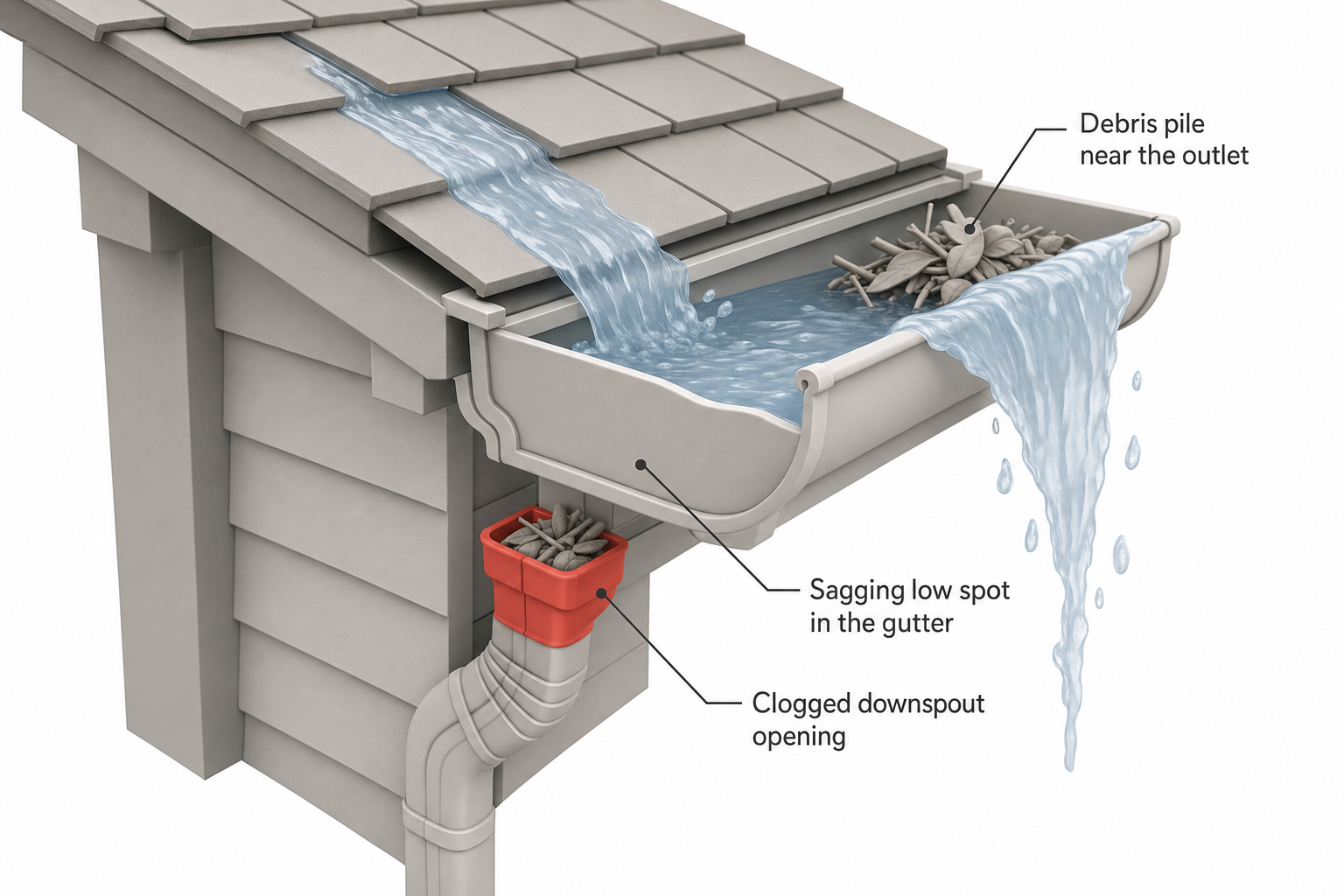
Before you touch a ladder, try to observe the system while it's actually raining, or right after a heavy storm while gutters are still wet. Look for these patterns, since each points to a different cause:
- Water spills over evenly along a long stretch — usually a capacity or slope problem, not a clog.
- Water spills over at one specific low spot — likely sagging gutter or a section that's lost its pitch.
- Water shoots out of a seam or corner — a joint failure or a clog just downstream of that point.
- Water backs up and pours over near a downspout, but the rest of the run is fine — almost always a clog inside the downspout or the outlet strainer.
- Water sheets over the entire front edge during heavy downpours only — likely an undersized gutter or downspout for your roof's drainage area.
Diagnosing and Fixing Clogs
Clogs are the most common cause of gutter overflow, particularly under trees or near roof valleys where debris concentrates.
Where clogs typically form
- Downspout outlets and strainers — leaves and granules from asphalt shingles collect right at the opening and choke flow even when the trough above looks clear.
- Inside elbows of the downspout — debris that makes it past the outlet often jams at the first bend.
- Gutter corners and end caps — these are low-flow zones where sediment and seed pods settle.
- Roof valleys feeding directly into a short gutter run — these dump a concentrated stream of water and debris into one spot, overwhelming it.
How to clear them
- Set up a stable extension ladder on firm, level ground, with the top resting against the fascia board, not the gutter itself, which can bend under pressure.
- Wearing gloves, scoop out loose debris by hand into a bucket or tarp rather than dropping it to the ground, where it can clog splash blocks or drains below.
- Flush the run with a garden hose starting at the end farthest from the downspout, working toward it, so you can watch for the water level rising, a sign of a blockage ahead.
- If water pools and won't drain into the downspout, feed a plumber's snake or a stiff wire down through the outlet to break up the clog, then flush again.
- For downspouts with persistent internal clogs, disconnect the lower elbow (most snap or slide together) and flush from the top down; gravity and hose pressure combined usually dislodge the blockage.
[!safety] Ladder work at roofline height is a leading cause of home injury falls. Keep three points of contact, never lean out to the side, have someone spot the base of the ladder, and stop if the roof or gutter is wet and slippery. If your home is more than one story or the roofline is steep, hire a licensed gutter cleaning or roofing contractor instead.
Preventing future clogs
Gutter guards and screens reduce debris buildup but don't eliminate the need for maintenance entirely — fine grit, shingle granules, and wind-blown seeds still get through most designs. Most manufacturers and roofing contractors recommend cleaning gutters at least twice a year, more often if you have overhanging trees, especially pines or trees that drop small seed pods.
Diagnosing and Fixing Pitch Problems
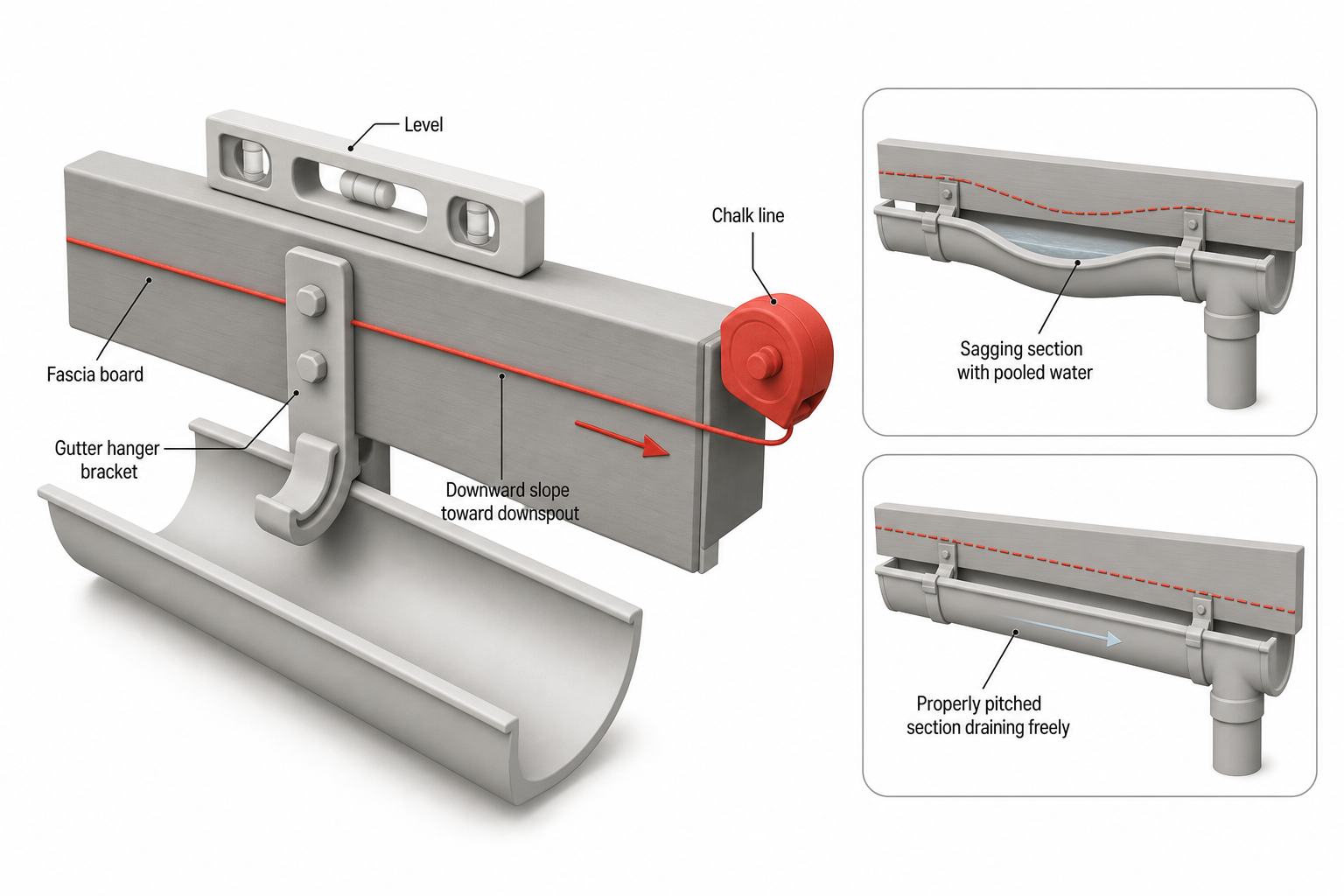
Gutters need a slight, consistent downward slope toward the downspout to move water efficiently. Most installers target roughly a 0.25in to 0.5in drop for every 10ft of gutter run. Over time, gutters can lose this pitch as fasteners loosen, fascia boards rot, or hangers get bent.
How to check the slope
- From the ladder, sight along the top inside edge of the gutter toward the downspout — you should see a gentle, continuous decline with no visible dips.
- Pour a bucket of water in at the far end and watch whether it flows smoothly to the downspout or stalls and pools partway.
- Standing water that remains in the gutter more than a few minutes after rain stops is the clearest sign of a low spot, even if the gutter isn't overflowing yet.
How to fix it
- Re-hang loose hangers: Locate the hidden hangers or spikes holding the gutter to the fascia (usually spaced every 24in to 36in) and re-secure any that have pulled loose, adjusting the gutter's height slightly at that point to restore a downward line toward the downspout.
- Replace failed fasteners: Old spike-and-ferrule fasteners often work loose over years of thermal expansion; swapping them for modern screw-in hanger brackets holds pitch far better.
- Address rotted fascia: If the fascia board itself is soft or crumbling, hangers won't hold no matter how well you adjust them. The rotted section needs to be cut out and replaced with sound lumber before the gutter can be properly re-pitched.
- Re-pitch a full run: For gutters that have sagged badly along their whole length, it's often faster to unclip the entire section, re-mark a fresh slope line with a chalk line and level, and reinstall hangers at the new pitch than to chase individual low spots.
[!safety] If fascia rot extends into the roof sheathing or trim, or if you find soft, spongy wood over a large area, treat it as a structural moisture problem rather than a simple gutter fix. Call a licensed contractor to assess and repair the framing before reinstalling gutters.
Diagnosing and Fixing Undersized Capacity
Even a perfectly clean, well-pitched gutter can overflow if it simply can't handle the volume of water coming off the roof during a heavy downpour. This is common on homes with large, steep roof planes, long roof valleys that concentrate runoff, or additions where the original gutter size was never upgraded.
Signs you have a capacity problem, not a clog or pitch issue
- Overflow happens only during intense, fast rainfall, not steady light rain.
- The gutters are clean, dry, and properly pitched during and after a normal storm.
- Overflow occurs consistently at the same spot below a roof valley or a particularly large roof section.
- You have a single downspout serving a very long gutter run.
Options for increasing capacity
- Add downspouts: A long gutter run with only one downspout at one end often overflows near the far end simply because water has too far to travel. Adding a second downspout partway along the run, or splitting a run into two shorter sections each with its own downspout, can resolve this without replacing anything else.
- Upsize the downspout: Standard residential downspouts are often 2in by 3in; larger sizes such as 3in by 4in carry significantly more water and are worth considering for roofs with large drainage areas or valleys.
- Upsize the gutter profile: Standard 5in K-style gutters are adequate for many homes, but larger roofs, steep pitches, or homes in areas with heavy rainfall often benefit from 6in gutters, which hold and move considerably more water before overflowing.
- Add a diverter at roof valleys: A small diverter or additional gutter apron at the base of a valley can spread the concentrated water flow across a wider section of gutter instead of dumping it all in one spot.
[!region] Rainfall intensity and code requirements for gutter and downspout sizing vary by climate and jurisdiction. Homes in regions with frequent heavy downpours may benefit from oversized gutters and downspouts even if local code doesn't mandate it — check with a local roofing or gutter contractor familiar with your area's typical storm intensity.
When to Call a Professional
Most clog removal and minor re-pitching is manageable as a DIY project for a comfortable ladder user. Call a licensed roofing or gutter contractor if:
- The problem requires work above the first story or on a steep roof.
- You find rotted fascia, soffit, or roof sheathing.
- The gutters need to be resized or the whole system reconfigured with new downspout locations.
- Overflow is causing water intrusion into the basement or foundation, which may need grading or drainage work beyond the gutters themselves.
FAQ
Why do my gutters overflow even right after I cleaned them? This usually points to a pitch or capacity problem rather than debris. Check whether water pools in a low spot after rain (a pitch issue) or whether overflow only happens during the heaviest part of a storm (a capacity issue), since a clean gutter can still overflow if it's poorly sloped or too small for the roof's runoff.
How often should I clean my gutters to prevent overflow? Most contractors recommend at least twice a year, in spring and fall, with more frequent cleaning if you have overhanging trees. Homes near pines or trees that shed seed pods often need quarterly attention.
Will gutter guards stop overflow completely? Guards reduce large debris like leaves but don't block fine grit, shingle granules, or wind-blown seeds, and they don't fix pitch or capacity problems. They're a maintenance-reduction tool, not a complete fix for overflow.
Can I just add a bigger downspout without replacing the whole gutter? Often yes — upsizing or adding a downspout is one of the more cost-effective fixes for capacity-related overflow and typically doesn't require replacing the gutter troughs themselves, as long as the gutter profile itself is a common size that accepts a larger outlet.
Is gutter overflow a sign of a bigger roof or foundation problem? Not usually on its own, but persistent overflow that isn't addressed can lead to fascia rot, siding damage, or water pooling near the foundation over time. If you're seeing water in a basement or crawlspace, it's worth having both the gutters and the grading around your foundation assessed together.