
Most "tool kit for new homeowners" lists are just gift-guide filler—dozens of items ranked by what's easy to photograph, not what you'll actually reach for. This list is built differently: it's ordered by repair frequency. The tools at the top are the ones you'll use in your first month of homeownership (hanging things, tightening things, plunging things). The tools further down handle problems that come up a few times a year. Skip straight to the recommendations below when you're ready to buy, but read the reasoning first so you don't overspend on tier-three tools while missing something you'll need next week.
Tier 1: You'll use these in the first 30 days
These solve the most common early-homeownership tasks: hanging pictures, tightening loose hardware, and dealing with a clogged drain.
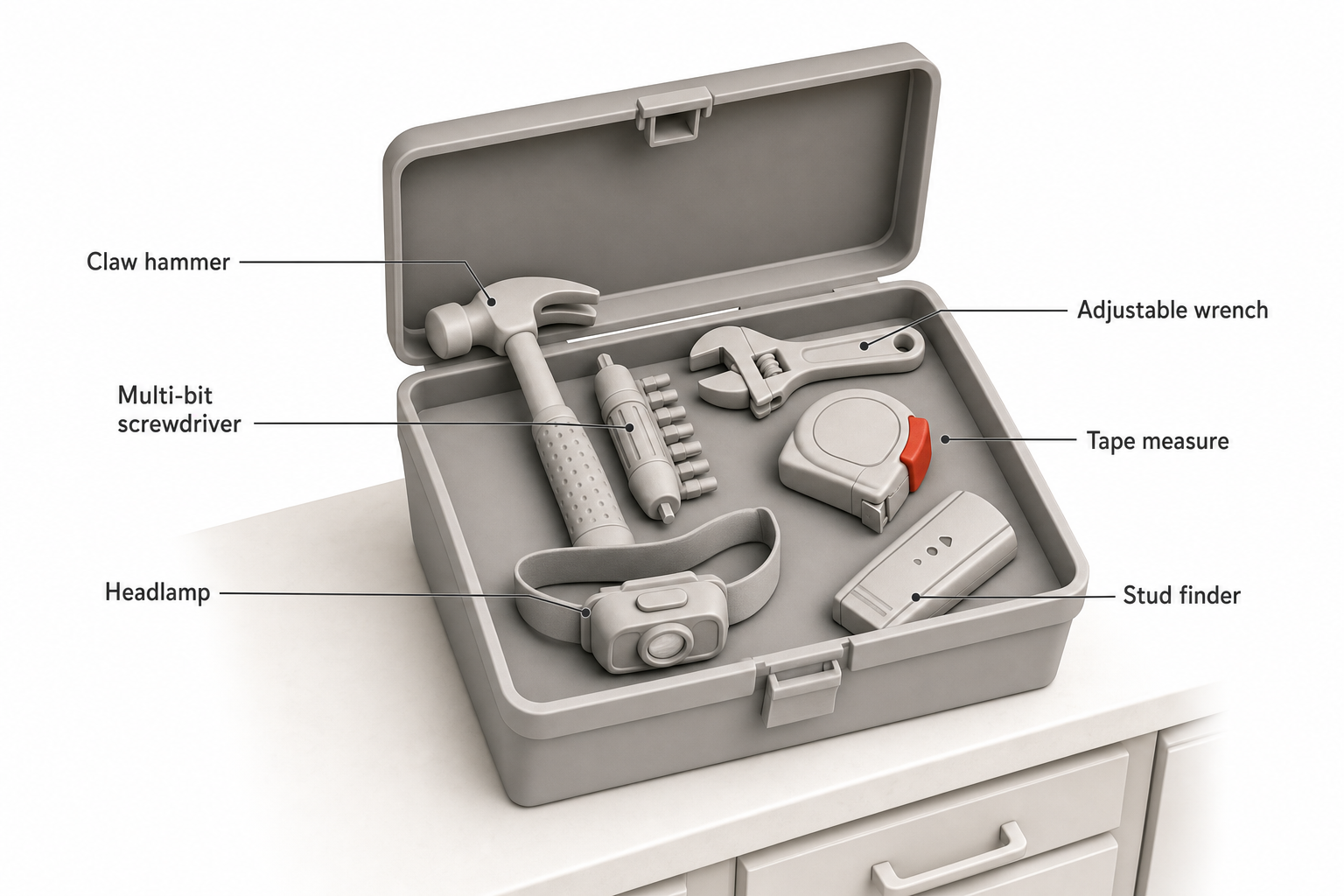
A claw hammer, 16 oz
A 16in curved-claw hammer in the 16 oz weight class is the standard all-purpose choice — light enough to control, heavy enough to drive picture hooks, small nails, and drywall anchors without excessive swinging. Avoid framing hammers (20 oz+) for general use; they're overkill and harder to control for small jobs.
A screwdriver set or a multi-bit driver
You need both Phillips and flathead in at least two sizes each — cabinet hinges, outlet cover plates, and appliance panels all use different sizes, and a screwdriver that doesn't fit the screw head will strip it. A single multi-bit screwdriver with a removable bit set covers most home needs in one handle; a full set of fixed screwdrivers is more comfortable for repetitive use but takes more drawer space.
An adjustable wrench, 8 inch
Covers supply-line nuts under sinks, some appliance connections, and stubborn bolts where you don't know the exact size. An 8in adjustable wrench is the most versatile single size for household plumbing and furniture hardware.
A tape measure, 25 ft
A 25ft tape with a locking blade handles furniture placement, curtain hanging, and rough room measurements. Look for a wide, stiff blade — it stays rigid over longer horizontal spans without buckling, which matters when you're measuring a doorway or a wall alone.
A flashlight or headlamp
Crawl spaces, breaker panels, and under-sink cabinets are rarely well lit. A headlamp frees both hands, which matters more than it sounds like it would the first time you're holding a wrench and a flashlight at the same time.
A plunger — cup and flange styles
A standard cup plunger handles sinks and tubs; a flange (toilet) plunger has an extra fold of rubber that seals better against a toilet's curved drain opening. Keep both — using a flange plunger on a flat sink drain, or a cup plunger on a toilet, is noticeably less effective because the seal doesn't form properly.
Tier 2: You'll need these within the first year
These come up for slightly less frequent but still common jobs — hanging shelves properly, dealing with squeaky doors, patching small holes, and minor electrical work.
A stud finder
Anything heavier than a picture frame — shelves, TV mounts, curtain rods with real weight — should anchor into a wall stud when possible. An electronic stud finder that also detects live wiring adds a safety margin over the cheapest magnetic-only models, which only find screws and nails already in the wall.
A level, 24 inch torpedo or box level
Shelves, picture frames, and curtain rods all look visibly wrong if they're off by even a couple of degrees. A 24in level is long enough to check most shelving spans accurately; a small torpedo level (around 9in) is more useful for outlet covers and smaller fixtures.
A set of pliers — slip-joint and needle-nose
Slip-joint pliers grip pipes, nuts, and stuck objects; needle-nose pliers handle small wire work, jewelry-thin fasteners, and reaching into tight gaps. Together they cover most gripping tasks a wrench can't.
A utility knife
Opening boxes is the obvious use, but a sharp utility knife is also the right tool for scoring drywall, trimming caulk lines, and cutting flooring underlayment. Keep spare blades — a dull blade is more likely to slip and cause injury than a sharp one, because it requires more force.
A basic voltage tester (non-contact)
Before touching any wiring — replacing an outlet cover, a light fixture, or a switch — a non-contact voltage tester confirms the circuit is actually dead. It's inexpensive insurance against assuming a breaker label is accurate, which it often isn't in older homes.
Drywall patch kit and spackle
Nail holes, minor dents, and small anchor holes are inevitable. A basic kit — lightweight spackle, a putty knife, and fine-grit sanding sponge — handles the vast majority of wall repairs a homeowner will face.
Tier 3: Occasional but worth owning
These aren't weekly-use tools, but when you need them, nothing else substitutes well.
A cordless drill/driver
Once you're past hand-tightening, a cordless drill speeds up furniture assembly, shelf mounting, and deck or fence hardware. An 18V or 20V (max) drill with two batteries is a common sweet spot — one battery charges while the other's in use. A drill with a built-in clutch setting prevents overdriving screws into softer materials like particleboard.
A hacksaw
Cutting bolts, pipes, or metal brackets down to size comes up rarely but has no good substitute when it does.
An adjustable pipe wrench
For plumbing jobs beyond supply-line nuts — larger drain fittings, older galvanized pipe — a pipe wrench's serrated jaws grip round pipe far better than a standard adjustable wrench.
A caulking gun
Re-caulking around a tub, sink, or window is a once-a-year-or-less job, but it's one most homeowners end up doing themselves rather than hiring out.
Fish tape or a wire coat hanger substitute
For running speaker wire, ethernet cable, or similar low-voltage lines through walls — an occasional but frustrating job without the right tool.
How to organize it
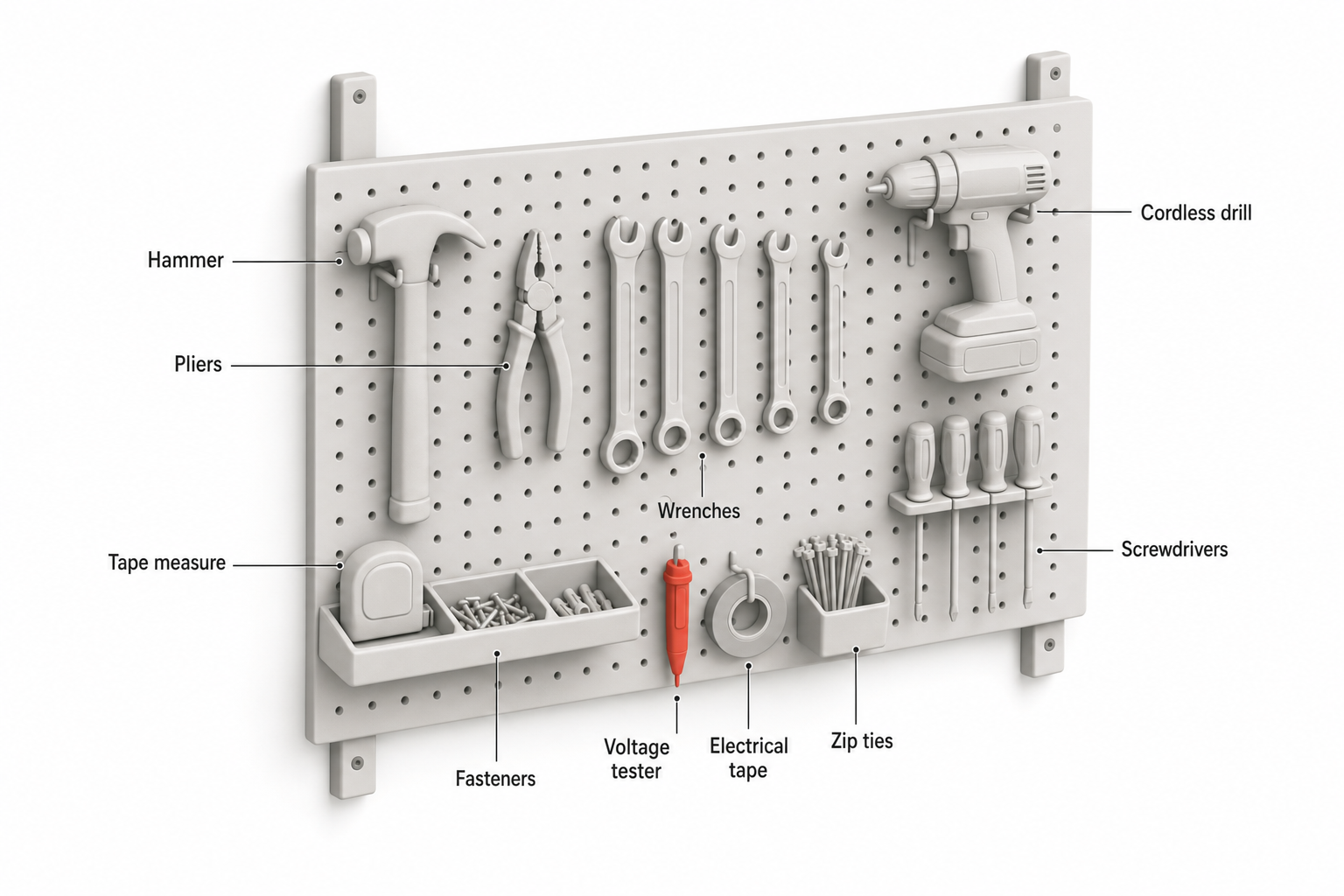
A single mid-size toolbox or a wall-mounted pegboard in a garage or utility closet works for most starter kits — the goal is that everything has one obvious spot, so you're not hunting during a small emergency like an overflowing toilet. Keep the plunger and voltage tester somewhere fast to grab, since those two get used under time pressure more than anything else on this list.
FAQ
Do I really need both a cup plunger and a flange plunger? Yes, if you want either one to work well. A flange plunger's extra rubber lip is shaped to seal inside a toilet's drain opening; on a flat sink or tub drain it just flops around. A cup plunger is the reverse — it seals fine on a flat surface but won't seat properly in a toilet bowl.
Is a cordless drill really optional for a first-time homeowner? It's genuinely useful but not urgent. Most Tier 1 and Tier 2 tasks — hanging things, tightening things, minor repairs — can be done by hand. A drill saves time on furniture assembly and larger mounting jobs, which is why it's listed in Tier 3 rather than as a day-one purchase.
What's the single most-skipped tool that people regret not having? The non-contact voltage tester. It's cheap, small, and easy to overlook, but it's the difference between safely swapping an outlet cover and accidentally touching a live wire because a breaker was mislabeled.
Should I buy a pre-assembled tool kit or build my own? Pre-assembled kits are fine for Tier 1 basics but often pad the box with low-quality or rarely-used items to hit a piece count. Building your own list, even slowly, usually gets you better individual tools for similar total cost — see the recommendations below for specific picks.
How much should a basic home toolkit for beginners cost to start? Costs vary a lot by tool quality and region, so it's not useful to quote a number here — but Tier 1 alone (hammer, screwdrivers, wrench, tape measure, flashlight, plunger) covers the large majority of first-month repairs, so it's a reasonable place to start before expanding into Tier 2.