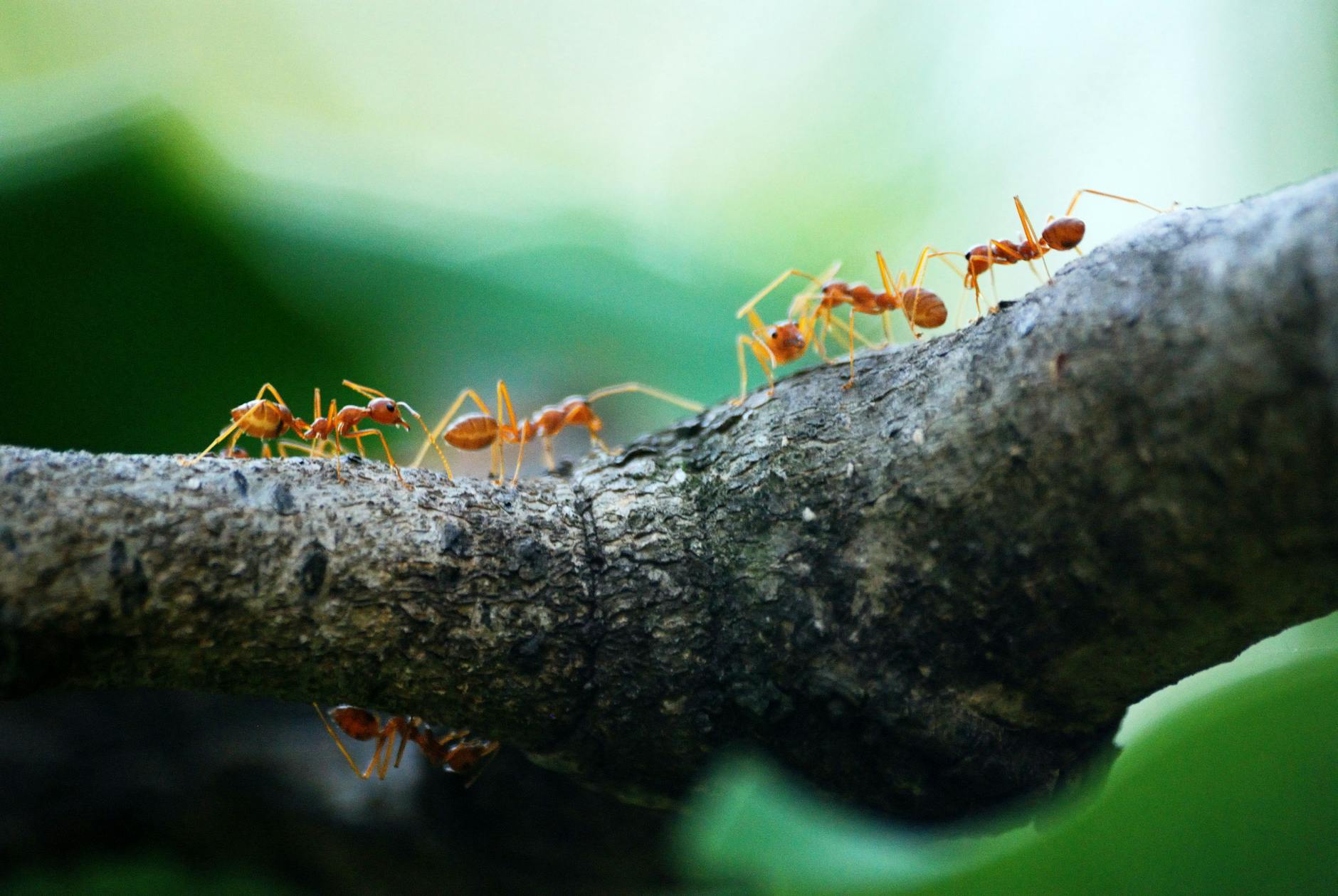
Spraying the ants you see on the counter feels productive, but it usually makes the problem worse. A contact spray kills the scouts crawling in the open while leaving the nest — and the queen producing more workers — completely untouched. The ants that vanish today are often back within a day or two, sometimes through a different crack. Getting rid of ants in the kitchen for good means treating it like a source problem: find how they're getting in, cut off the trail communication, and use bait so the colony poisons itself from the inside.
Why Spray-and-Wipe Doesn't Solve It
Ants navigate by pheromone trails laid down by scouts. When you wipe or spray a visible trail, you kill or scatter a handful of workers, but the colony — which can number in the thousands and live behind a wall or under a slab outside — sends out new scouts to re-establish a path. Sprays containing pyrethroids can also make some ant species scatter and "bud off" into satellite colonies, which is why a kitchen that had one trail sometimes ends up with ants in two or three rooms after repeated spraying. The goal below is to work with the colony's own behavior instead of against it.
Step 1: Find the Trail, Not Just the Ants
Before you clean anything, spend a few minutes watching. Ants at a food source are moving in a line, not randomly — follow that line backward to where it disappears, which is usually a gap at a baseboard, a window frame, a plumbing penetration under the sink, or a crack around a door threshold.
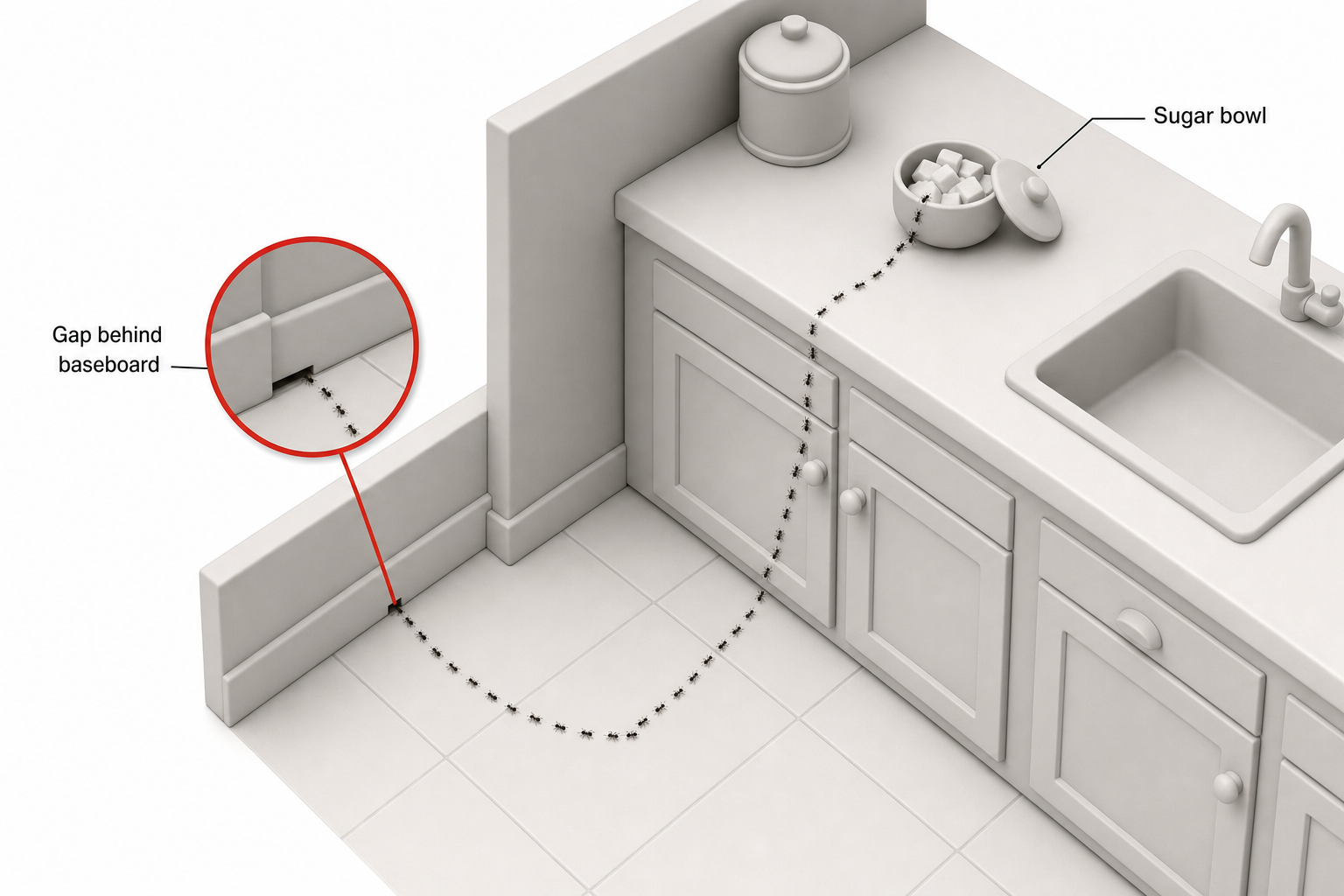
Common entry points in kitchens include:
- Gaps under sink cabinets where supply lines and drain pipes pass through the cabinet floor
- Cracks in exterior wall foundations near the kitchen, especially at slab-to-wall joints
- Gaps around window and door frames, particularly on the side of the house that gets morning sun
- Expansion gaps around dishwasher and refrigerator water lines
- Unsealed gaps where a range hood or exhaust vent penetrates the wall
If you can't find a live trail, put out a small dab of honey or a scrap of greasy meat on a plate overnight and check at first light — most kitchen ant activity peaks in early morning or after dark.
Step 2: Erase the Pheromone Trail
Once you've located the trail, wipe it down with a solution of warm water and a squirt of dish soap, or a diluted vinegar solution. Mix roughly 1gal of warm water with a few tablespoons of dish soap for a full countertop and floor wipe-down. This breaks down the pheromone scent markers so new scouts can't simply follow the old path back to your counter. Do this along the entire visible trail, not just where the ants are clustered.
Step 3: Seal the Entry Points
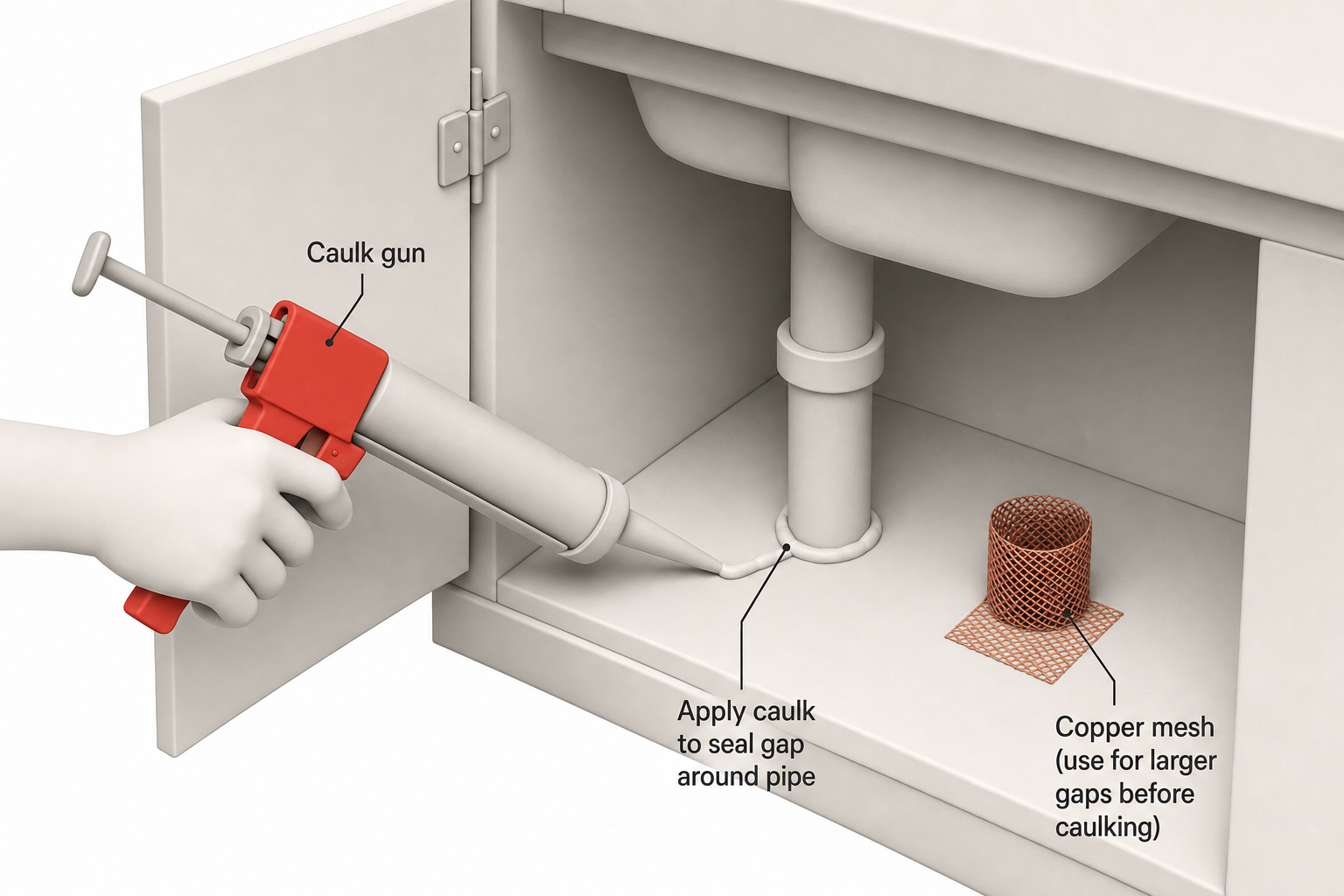
This is the step most spray-only approaches skip, and it's the one that actually stops future invasions. Use a paintable silicone or acrylic latex caulk to seal cracks and gaps under 0.25in wide around baseboards, window frames, and pipe penetrations. For larger gaps around pipes entering through cabinet floors, pack in a bit of steel wool or copper mesh before caulking — ants and other pests won't chew through metal the way they can push past dried caulk that's cracked.
Outside, check where the foundation meets siding near the kitchen wall and where utility lines enter the house. Weatherstripping worn thin around exterior doors is another common gap — if you can see daylight under the door, ants can walk through it.
Step 4: Set Out Bait, Not Spray
Bait is the actual fix for an established trail. A bait, whether a gel placed in small dots near the trail or a pre-filled bait station, contains a slow-acting toxicant mixed with something ants find attractive — usually a sugar or protein base depending on species and season. Worker ants carry it back to the nest and feed it to the colony, including the queen, which is the only way to actually reduce the population rather than just the visible scouts.
A few practical rules for bait to actually work:
- Place bait directly on or right next to the trail you identified in Step 1, not just anywhere in the kitchen
- Use several small placements rather than one large one — ants prefer choice and multiple feeding points speed up colony pickup
- Space stations roughly every 3ft to 6ft along a long trail so workers encounter one quickly
- Do not spray insecticide near the bait — it will repel ants from feeding on it and undo the strategy
- Expect to see more ants at the bait for the first several days as workers recruit others to the food source; this is a sign it's working, not a sign it's failing
- Leave bait in place for at least one to two weeks even if visible activity drops off within days, to make sure the colony fully collapses
Gel baits work well tucked into cracks and along baseboards where kids and pets can't easily reach them; enclosed bait stations are a safer option if you have curious pets or toddlers in the kitchen.
Step 5: Remove the Reasons They Came Back
While bait does its work, cut off competing food sources so ants have less reason to ignore the bait:
- Store sugar, cereal, pet food, and other pantry staples in sealed containers rather than their original bags
- Wipe up spills and crumbs the same day, especially around the stove and under small appliances
- Take out the trash regularly and rinse recyclables that held anything sugary
- Fix any small drips under the sink or around the dishwasher — many common kitchen ant species are drawn to moisture as much as food
Step 6: Check for an Outdoor Nest
Most kitchen ant problems trace back to a colony living outside — in mulch beds, under a patio slab, in a woodpile, or inside a wall void. If you can trace the trail to an exterior wall, look for a small mound of loose soil or sawdust-like debris nearby, which can indicate a nest location. Treating that area with an outdoor bait product formulated for that purpose, following the label directions, often does more to solve a recurring kitchen problem than anything applied indoors.
When to Call a Professional
If you've sealed obvious entry points, cleaned trails, and maintained bait for two to three weeks with no improvement, or if you're finding large numbers of winged ants indoors (a sign of a mature colony swarming to reproduce), it's reasonable to bring in a licensed pest control professional. They can identify the species precisely and access void spaces or exterior nests that aren't practical to treat yourself.
FAQ
Why do I have more ants after I put out bait? This is normal and usually means the bait is working — worker ants recruit nestmates to a good food source, so activity often increases for several days before it drops off as the colony declines.
Will vinegar keep ants away permanently? Vinegar and soapy water are effective at erasing pheromone trails so ants stop following an old path, but they don't kill the colony or stop new scouts from finding another way in. Pair trail cleaning with sealing entry points and baiting for a lasting fix.
Is it safe to use bait if I have pets or small children? Enclosed bait stations are generally the safer choice when pets or kids are around, since the toxicant is contained inside a shell. If you use gel bait, place small dots inside cracks, behind appliances, or under cabinets where they can't be easily reached.
How long does it take to get rid of ants in the kitchen with bait? Most established trails show noticeably reduced activity within one to two weeks, but leave bait in place for the full period even if you stop seeing ants sooner — an early pickup often means the colony hasn't fully collapsed yet.
Should I just call an exterminator instead of doing this myself? For a first-time or mild kitchen ant trail, sealing entry points and baiting usually resolves it without professional help. It's worth calling a licensed pest control provider if the problem recurs repeatedly, involves a nest inside a wall, or doesn't improve after a few weeks of consistent effort.