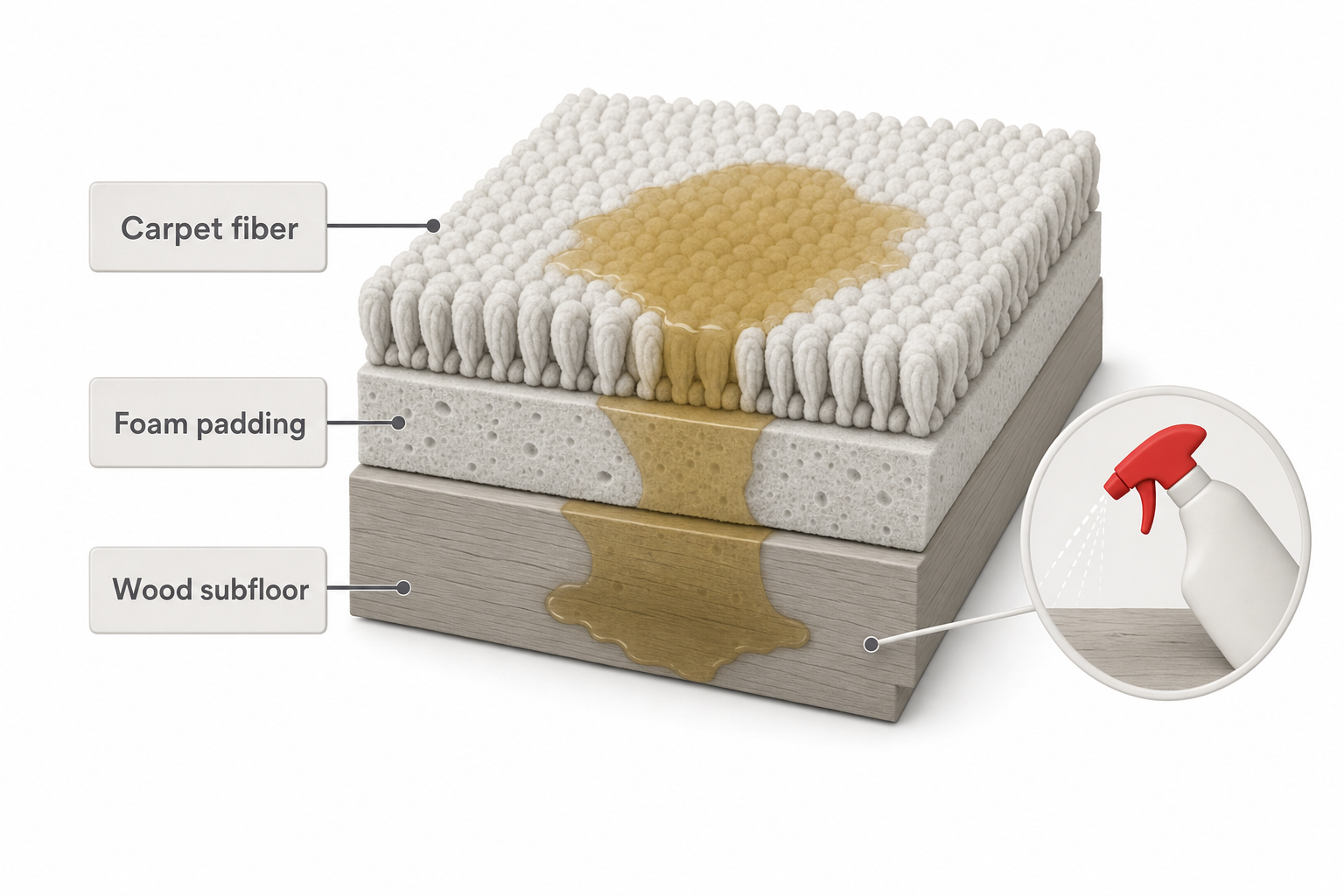
If your carpet still smells like pet urine days (or months) after the accident happened, the problem probably isn't the carpet fibers anymore—it's what's underneath them. Urine wicks down through carpet into the padding and sometimes into the subfloor itself. Once that happens, surface sprays, steam cleaning, and even rented carpet shampooers only treat the top layer, and the smell comes back the moment humidity rises or the spot gets stepped on. Permanently removing pet urine odor means treating every layer the urine reached, and that usually requires an enzymatic cleaner rather than a general-purpose deodorizer.
Why Regular Cleaners Don't Work
Urine odor comes from bacteria breaking down uric acid crystals, and those crystals are not water-soluble. Vacuuming, blotting, or cleaning with soap and water can lift surface residue, but uric acid crystals stay bonded to fibers and padding and reactivate—releasing odor again—whenever they get damp. Fragranced carpet powders and most all-purpose cleaners only mask the smell temporarily because they don't break down the crystals themselves.
Enzymatic cleaners work differently: they contain bacterial cultures or enzymes that digest the uric acid and organic waste, breaking it down into odorless compounds instead of just covering the smell. This is why enzymatic treatment is the core of any permanent fix, whether the accident happened yesterday or years ago.
Step 1: Find Every Affected Spot
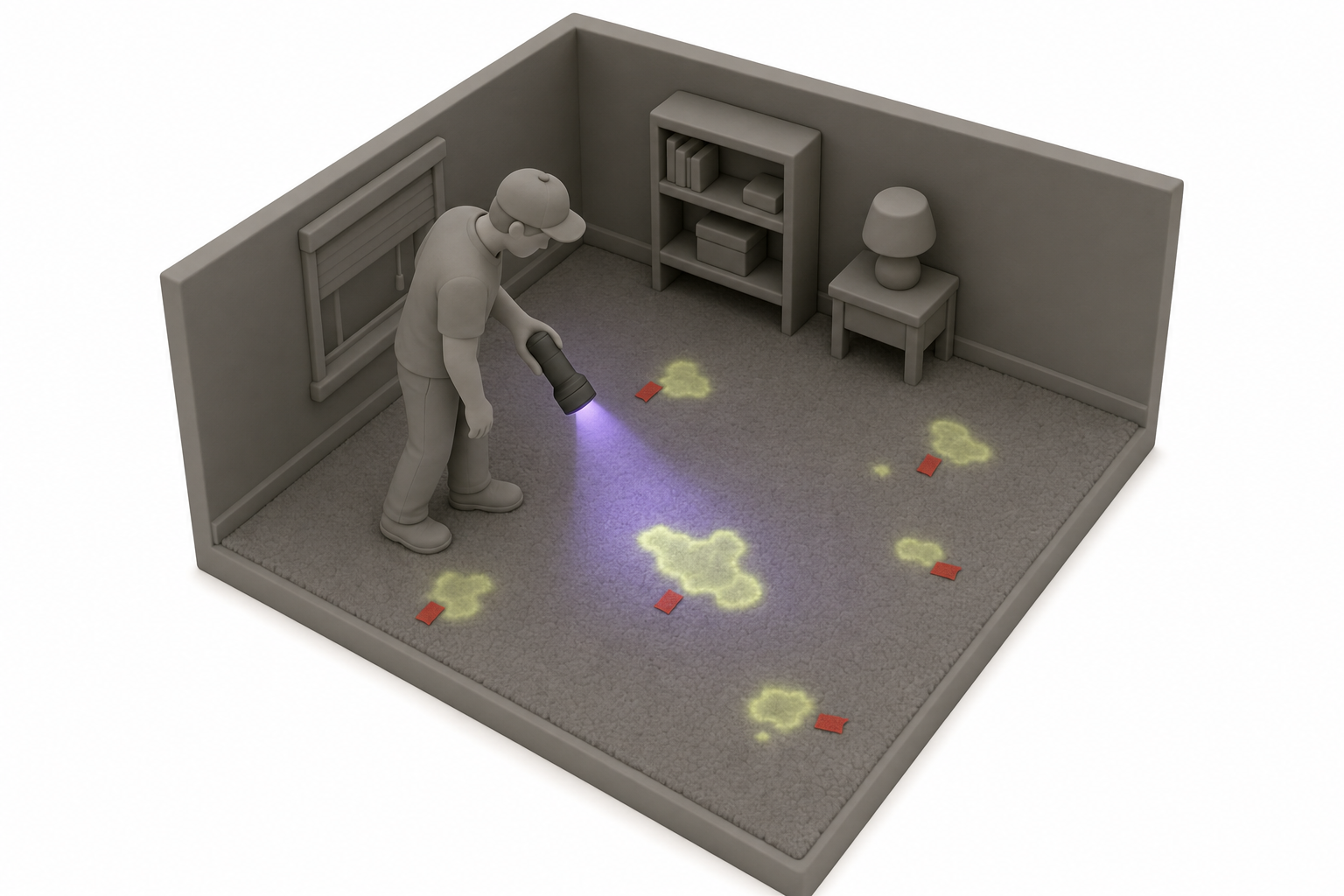
Old or dried stains aren't always visible, so before treating anything, locate the full extent of the contamination.
- UV (black light) inspection: Dried urine glows yellow-green under a UV flashlight in a darkened room. Walk the room slowly at night with the lights off, marking spots with painter's tape or sticky notes as you find them.
- Nose test: Odor often intensifies in humid weather or after the carpet gets warm from sunlight or heating vents—use this to confirm suspect areas.
- Check the full depth: Press firmly on a suspected spot with a white cloth. If moisture or discoloration comes up, the contamination likely extends into the padding.
Step 2: Deep-Clean the Carpet Fibers With an Enzymatic Cleaner
- Blot, don't scrub, any fresh stains first. Scrubbing pushes urine deeper into the pad and spreads it laterally. Use clean white towels and press down repeatedly until no more moisture transfers.
- Saturate the marked area with an enzymatic cleaner, not just spray the surface. The solution needs to reach the same depth the urine did, so pour or apply enough that it soaks through the carpet into the pad below—this is usually far more product than a light surface spritz.
- Cover with plastic wrap or a plastic bag for the dwell time listed on the product, typically several hours to overnight. This keeps the solution from drying out before the enzymes finish working; enzymes need to stay moist and active to break down the uric acid.
- Blot dry with clean towels, then let the area air dry completely, ideally with a fan or dehumidifier running to prevent mold growth in the damp pad.
- Repeat if odor persists after the carpet is fully dry—old, heavily saturated spots often need two or three treatment cycles.
[!safety] Never mix an enzymatic cleaner with bleach, ammonia, or other chemical cleaners. Combining cleaning chemicals can produce toxic fumes, and bleach or ammonia will kill the active enzymes before they can break down the odor source.
Step 3: Treat the Padding and Subfloor
If the UV inspection shows large glowing areas, if the smell returns after fiber-level treatment, or if a spot has been unaddressed for a long time, the padding underneath has likely absorbed urine that surface treatment can't reach.
When to Pull Back the Carpet
For any stain larger than a dinner plate, or any spot where the padding feels stiff, crusty, or damp long after the surface has dried, it's worth pulling the carpet back to inspect and treat the pad directly.
- Locate the tack strips at the room's perimeter and gently lift the carpet edge with pliers or a flathead screwdriver near the affected area.
- Peel back the carpet (it should separate from the tack strip without cutting) and examine the pad. Urine-soaked padding often looks discolored—yellowed or dark—and may feel crunchy when dry from crystallized residue.
- Cut out and discard heavily contaminated padding. Padding is inexpensive and far more porous than carpet or subfloor; in most cases it's more effective to replace the affected section than to try to fully deodorize it in place.
- Treat the exposed subfloor (wood, concrete, or particleboard) with an enzymatic cleaner formulated for that surface, following the same soak-and-dwell approach. For wood or particleboard subfloors that have visible staining, a shellac-based stain-blocking primer applied after the subfloor is completely dry can permanently seal in any remaining odor.
- Allow the subfloor to dry fully—this can take 24-48 hours depending on humidity and airflow—before installing new padding.
- Re-stretch and re-secure the carpet, or call a flooring professional for re-installation if the area is large or the carpet needs re-stretching over new padding.
[!safety] If you discover water damage, mold growth, or a soft/spongy subfloor while pulling back carpet, stop and assess before proceeding. Extensive mold or structural softening in a subfloor may require a licensed contractor or mold remediation specialist rather than a DIY fix.
Step 4: Prevent Recontamination While You Wait for Odors to Fully Clear
- Block pet access to the treated area with furniture, a baby gate, or a chair placed upside down over the spot until it's completely dry and odor-free.
- Address the underlying behavior—consult a veterinarian if repeated accidents in the same spot suggest a medical or anxiety issue rather than a training lapse.
- Avoid steam cleaning a spot before enzymatic treatment is finished; heat can set the odor by bonding uric acid proteins more permanently to fibers, making later enzyme treatment less effective.
[!region] Carpet disposal and padding replacement requirements can vary by municipality—some areas require padding or carpet remnants to be bagged separately from regular household trash, or accept them only at specific waste facilities. Check with your local waste management authority before discarding contaminated padding.
FAQ
Will steam cleaning alone get rid of pet urine smell? Usually not permanently. Steam cleaning can lift surface residue and temporarily reduce odor, but heat can also set uric acid proteins into the fibers, and it does nothing for urine that has soaked into the padding or subfloor, so the smell often returns.
How do I know if the smell is coming from the pad, not just the carpet? If an enzymatic treatment on the carpet surface doesn't resolve the odor after one or two full treatment-and-dry cycles, or if a UV light shows a large glowing area, the padding or subfloor is likely still contaminated and needs direct treatment.
Can I use baking soda or vinegar instead of an enzymatic cleaner? Baking soda and vinegar can help absorb and neutralize odor temporarily, but they don't break down uric acid crystals the way enzymes do, so they're better used as a supplement after enzymatic treatment rather than a replacement for it.
How long does enzymatic treatment take to work? Most products need a dwell time of several hours to overnight while kept moist, and heavily soaked or old stains may need two to three repeated treatments over several days before the odor is fully gone.
Is it ever better to just replace the carpet? For extensive, long-term contamination across a large area—especially if the subfloor is affected in multiple spots—replacing the carpet and padding can be more reliable and sometimes more cost-effective than repeated deep treatment, particularly in homes with multiple pets or a long history of accidents in the same room.