
A jammed garbage disposal is one of the most common kitchen appliance problems, and it's also one of the most misunderstood. Many homeowners reach straight for a drain-cleaning chemical or, worse, stick a hand down the drain to feel around for the blockage. Both are bad ideas. Chemicals can pit the disposal's metal components and are dangerous to handle, and disposals don't actually have exposed spinning blades — they have blunt metal impellers that can still crush or pinch a finger if the unit unexpectedly powers on.
The good news: most clogs and jams can be cleared in under 15 minutes using two tools that came with the unit or are cheap to buy — a hex (Allen) wrench and the disposal's own reset button — without ever putting your hand inside.
Step 1: Cut the Power Completely
Most disposals plug into an outlet under the sink — find it and unplug it. If yours is hardwired instead, switch off the corresponding circuit breaker. Don't rely solely on the wall switch; treat the unit as live until it's unplugged or the breaker is off.
Step 2: Try the Reset Button First
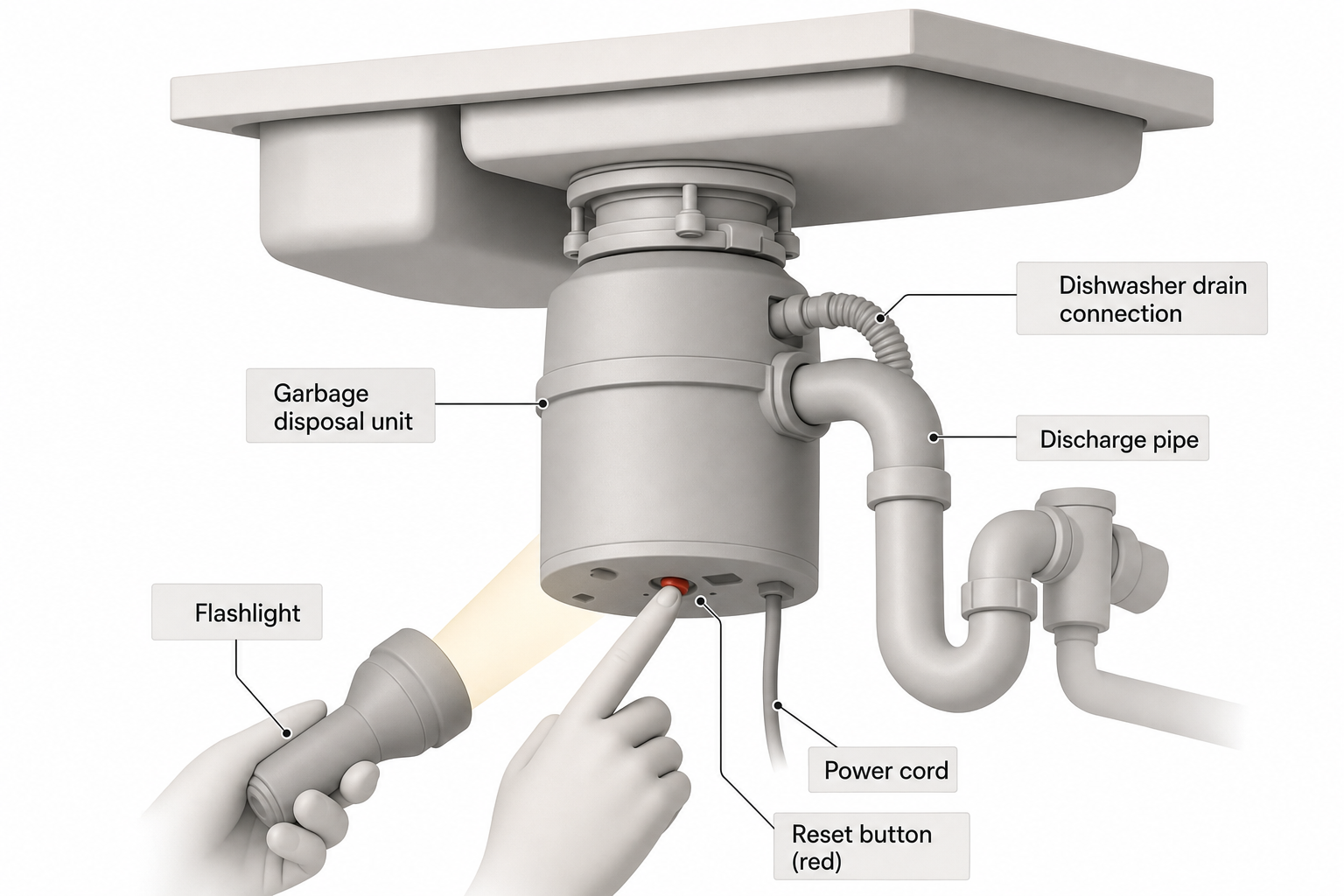
On the bottom of the disposal unit (you may need a flashlight to see it), there's a small red or black reset button. Disposals have a built-in thermal overload protector that trips this button when the motor overheats or stalls — often the actual cause of a disposal that just hums or does nothing when switched on.
Push the reset button firmly until you hear or feel a click. If it doesn't click or immediately trips again, there's likely still a physical obstruction, and you'll want to continue to the manual clearing steps below.
Step 3: Look for the Hex Hole and Use an Allen Wrench
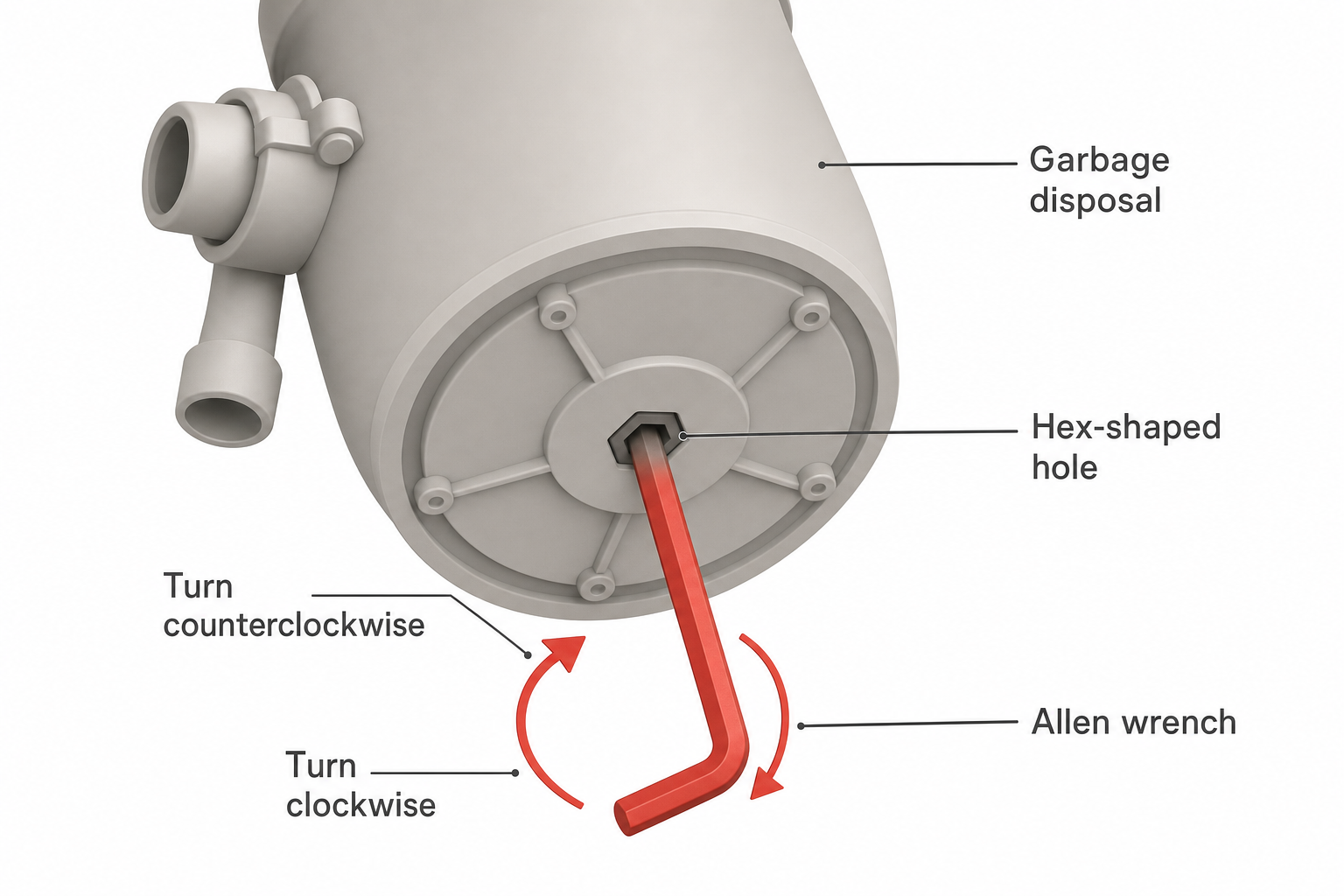
Most residential disposals have a hexagonal-shaped hole in the center of the bottom of the unit — this connects directly to the motor shaft and impeller plate. Many units ship with a small 1/4-inch offset Allen wrench specifically for this purpose; if you no longer have it, a standard 1/4-inch hex key from a hardware store works too (check your model's manual for the exact size, as it can vary).
- Insert the wrench into the hex hole.
- Turn it firmly in both directions — clockwise and counterclockwise — to manually rotate the impeller plate.
- You're trying to physically break up whatever is jamming the plate: a fruit pit, bone fragment, glass shard, or fibrous food like celery or corn husk.
- Keep working the wrench back and forth until it spins freely through a full rotation without resistance.
This step does the same job as reaching in with your hand, but the wrench keeps your fingers a safe distance from the impeller plate the entire time, even though the unit should already be unplugged.
Step 4: Check the Drain Opening (With a Flashlight, Not Your Hand)
Once the impeller spins freely from below, look down into the drain opening from the sink side using a flashlight. If you can see an object lodged near the top — a bottle cap, a piece of broken glass, or a wedged utensil — use long tongs or needle-nose pliers to retrieve it. Never use your fingers to fish something out, even with the power confirmed off; treat the assumption that it's off as unreliable and keep hands clear on principle.
Step 5: Restore Power and Test With Water Running
Plug the unit back in or flip the breaker back on. Turn on the cold water tap at the sink, then switch on the disposal. Running cold water (not hot) while operating the disposal helps solidify any remaining grease residue so it can be ground up and flushed through rather than smearing along the pipe walls.
If the disposal now runs and drains normally, you've cleared the clog. If it still hums without spinning, repeat Steps 1–3 — there may be a second obstruction, or the reset button may need to be pressed again after the jam is cleared.
When to Skip the Chemicals Entirely
Liquid drain cleaners are marketed as a quick fix, but they're a poor match for garbage disposals specifically:
- They can sit in the disposal chamber and corrode the metal impeller plate and housing over time.
- If the clog is only partially cleared, the caustic chemical can splash back up through the sink opening when you next run the disposal.
- They do nothing for a mechanical jam (a lodged object), which is the most common cause of a disposal that hums but won't spin.
If the Allen wrench method doesn't restore free movement, the issue may be a deeper clog in the drain trap or pipe past the disposal, a failed motor, or a broken impeller. At that point, a plumber's snake worked through the trap (after removing it) can help, or it may be time to call a licensed plumber or appliance repair technician rather than continue troubleshooting.
Preventing Future Clogs
- Run cold water for a few seconds before, during, and after each use.
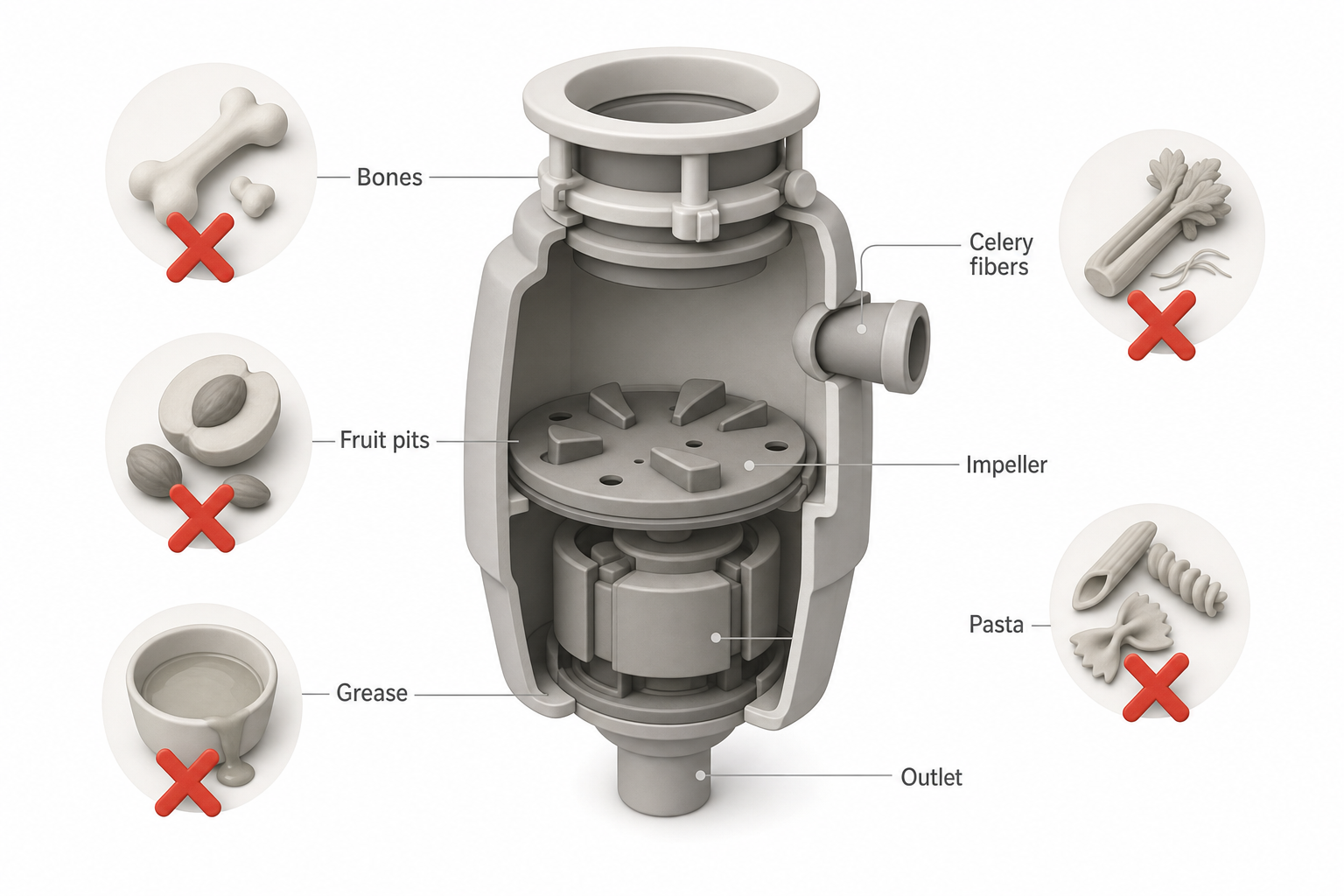
- Avoid grinding fibrous foods (celery, onion skins, corn husks), starchy foods (pasta, rice) that expand, and hard items (bones, fruit pits) — check your model's manual, since grinding capability varies by disposal type.
- Never pour grease or oil down the drain; it solidifies in the pipes even if it passes through the disposal fine.
- Run the disposal regularly, even when the sink isn't full of scraps, to keep the impeller plate moving freely.
FAQ
Is it safe to put my hand in a garbage disposal if it's unplugged? It's best to avoid this entirely. Even when unplugged, sharp debris like glass or metal fragments can be inside, and there's always a small risk of miswiring or an unexpected power source. The Allen wrench and tongs let you clear the unit just as effectively without that risk.
Why does my disposal just hum instead of spinning? A hum usually means the motor is receiving power but the impeller plate is physically jammed by an object, or the thermal overload has tripped and needs the reset button pressed. Working the Allen wrench through the hex hole to free the plate, then pressing reset, resolves most humming disposals.
Can I use baking soda and vinegar instead of chemical drain cleaner? This combination is generally considered a gentler alternative for freshening odors and can help with minor drain buildup, but it won't clear a mechanical jam caused by a stuck object, so it isn't a substitute for the reset button and Allen wrench method when the unit won't spin at all.
How often should I expect to need to clear a jam? This varies a lot by household and what commonly goes down the drain, but frequent jams often point to grinding items the disposal isn't designed for, such as fibrous vegetable scraps or bones — adjusting what goes into it usually reduces how often clogs occur.
What size Allen wrench fits a garbage disposal? Many residential units use a 1/4-inch hex wrench, and some come with a dedicated offset wrench in the box for this exact purpose, but sizes can differ by manufacturer, so check the unit's manual or the hex hole itself before buying a replacement.