
A toilet that keeps running — or that cuts on by itself every few minutes — is almost always caused by one of three parts inside the tank: the flapper, the fill valve, or the float. The good news is that all three are cheap to replace and none require special tools. This guide walks through the fix in the order of what's most likely to be the culprit and easiest to check first, so you're not guessing.
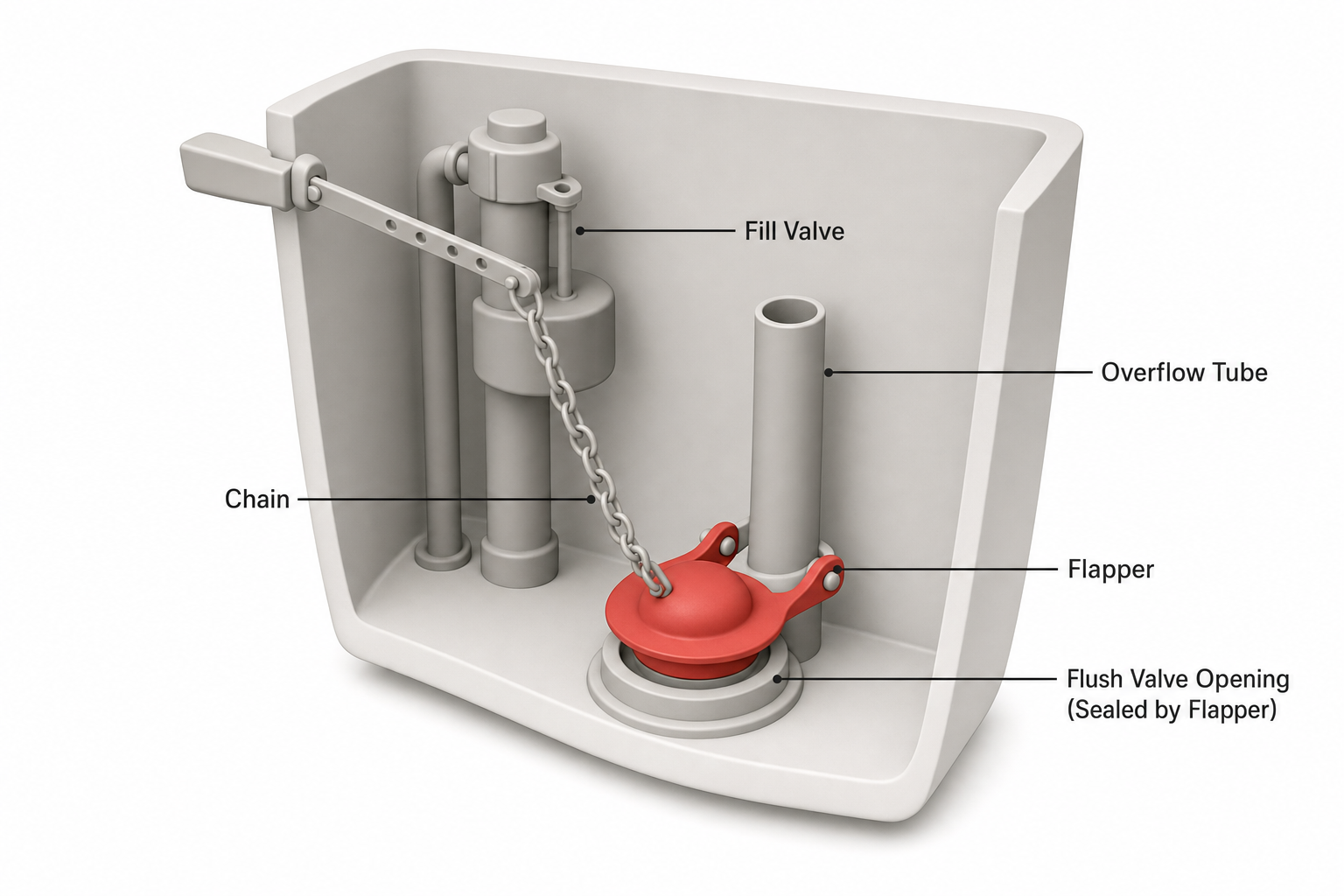
Before diving in, understand the basic mechanism: when you flush, the flapper lifts and lets tank water drain into the bowl. As the tank empties, a float drops, which opens the fill valve to refill the tank. Once the water reaches the fill line, the float rises and shuts the valve off. If the toilet runs constantly, water is escaping somewhere it shouldn't — usually past a worn flapper — or the fill valve isn't shutting off completely.
Step 1: Check the Flapper (Most Common Cause)
The flapper is a rubber or silicone disc at the bottom of the tank that seals the flush valve opening. It degrades over time — rubber gets brittle, warps, or develops a mineral coating that keeps it from sealing flush against the valve seat. This causes a slow, silent leak from tank to bowl that keeps triggering the fill valve.
- Remove the tank lid and set it aside on a towel so it doesn't chip.
- Add a few drops of food coloring to the tank water and wait 10in — actually, wait 10 minutes without flushing.
- Check the bowl. If colored water has seeped in, the flapper isn't sealing.
- Inspect the flapper itself: feel for a slimy or gritty film, cracks, or warping. Also check that the chain connecting it to the flush handle isn't too short (holding the flapper open) or too long (letting it fold and stick under itself).
Fix: Adjust the chain first — it should have about 0.5in of slack when the flapper is closed, with no kinks. If the flapper looks worn, warped, or coated, replace it. Flappers are sold in universal sizes (2in and 3in are the most common flush valve diameters), so measure the opening before buying — see the recommendations below for compatible replacements. Installation is push-on: unhook the old one from the pegs on either side of the overflow tube, snap the new one on, and reattach the chain.
Step 2: Check the Fill Valve
If the flapper seals properly (no color leaked into the bowl) but the toilet still runs or makes a periodic refill sound, the fill valve is the likely cause. Fill valves are the tall assembly on the left side of the tank (in most standard configurations) that controls the water refill.
Common fill valve failures:
- Won't shut off completely — water trickles into the overflow tube constantly. Sediment in the valve seat is the usual reason.
- Cycles on and off periodically — the valve is letting water seep past its seal, slowly lowering the tank level until it retriggers a refill.
- Water level set too high — water constantly dribbles into the overflow tube because the shutoff point sits above the tube's rim.
Fix, in order of effort:
- First, check the water level. It should sit about 1in below the top of the overflow tube, or at the fill line marked on the tank if there is one. If it's higher, adjust the float (see Step 3) before replacing anything.
- If the level looks correct but water still trickles, try flushing and watching the valve cap — some styles have a knob or cap you can lift and clean of debris.
- If cleaning doesn't help, replace the fill valve. This is a straightforward swap: shut off the water supply at the wall valve, flush to drain the tank, disconnect the supply line and the mounting nut underneath the tank, then remove the old valve and install the new one, adjusting its height so the top sits at least 1in above the overflow tube per the new valve's instructions.
[!safety] Before disconnecting any water line, confirm the shutoff valve at the wall fully stops water flow. If the shutoff valve is stuck, corroded, or doesn't fully close, don't force it — a seized valve can crack and cause a much bigger leak. Call a licensed plumber to replace a faulty shutoff before proceeding.
Step 3: Check and Adjust the Float
The float — either a ball on an arm or a cup that rides up and down the fill valve shaft — tells the fill valve when to shut off. If it's set too high, water constantly spills into the overflow tube and the toilet runs nonstop. If the float itself has cracked and taken on water, it won't rise properly and will cause the same problem.
- With the tank lid off, flush and watch the float rise as the tank fills.
- If water is still trickling into the overflow tube after the float appears to have stopped rising, the float is set too high or is waterlogged.
- For a ball-and-arm float: gently bend the arm downward, or turn the adjustment screw at the base of the arm if present, to lower the shutoff point.
- For a cup-style float on a fill valve shaft: pinch the adjustment clip and slide the cup down the shaft.
- If you shake the float ball and hear water sloshing inside, it's cracked — replace it. Ball floats can usually be unscrewed from the arm and swapped for a new one.
After adjusting, flush again and confirm the water settles at least 1in below the overflow tube rim with no further trickling.
[!region] Some municipalities and water utilities offer rebates or free toilet flapper/fill valve kits as part of water-conservation programs — check with your local water provider, since a running toilet can waste a significant amount of water over a billing cycle.
When None of These Fix It
If you've replaced the flapper, fill valve, and adjusted the float and the toilet still runs, consider these less common causes:
- Cracked flush valve seat (the fixture the flapper seals against) — this usually requires replacing the entire flush valve assembly, which means removing the tank from the bowl.
- Warped or cracked tank — rare, but a hairline crack can cause water to seep out slowly.
- High water pressure feeding the fill valve too fast, causing it to fail prematurely — a pressure-reducing valve on the home's main line may be worth having checked.
[!safety] Removing a tank from the bowl involves lifting a heavy porcelain component and working with bolts that can crack the tank if overtightened. If you're not comfortable with this step, call a licensed plumber rather than risk cracking the tank or bowl.
FAQ
How do I know if my toilet is running even if I can't hear it? Do the food-coloring test: add a few drops to the tank, wait 10–15 minutes without flushing, and check whether color appears in the bowl. Silent leaks past the flapper are common and can go unnoticed for months.
How much water does a running toilet actually waste? It varies widely with the size of the leak, but even a slow, silent leak can waste a meaningful amount of water over a billing cycle — enough that many water utilities recommend checking toilets during routine home maintenance.
Can I use vinegar to clean mineral buildup on the flapper or valve seat instead of replacing parts? A vinegar soak can help dissolve light mineral scale on the flush valve seat or flapper, but if the rubber is already cracked, warped, or hardened, cleaning won't restore a proper seal — replacement is the more reliable fix.
Why does my toilet randomly run for a few seconds every hour? This "phantom flush" pattern almost always points to a slow flapper leak: water seeps past the flapper gradually, the tank level drops enough to trigger the fill valve, it tops off, and the cycle repeats.
Is it safe to leave a running toilet overnight before I can fix it? Yes, it isn't a safety hazard, but it does waste water continuously. If it's the fill valve failing to shut off entirely, you can turn off the shutoff valve behind the toilet until you're ready to make the repair.