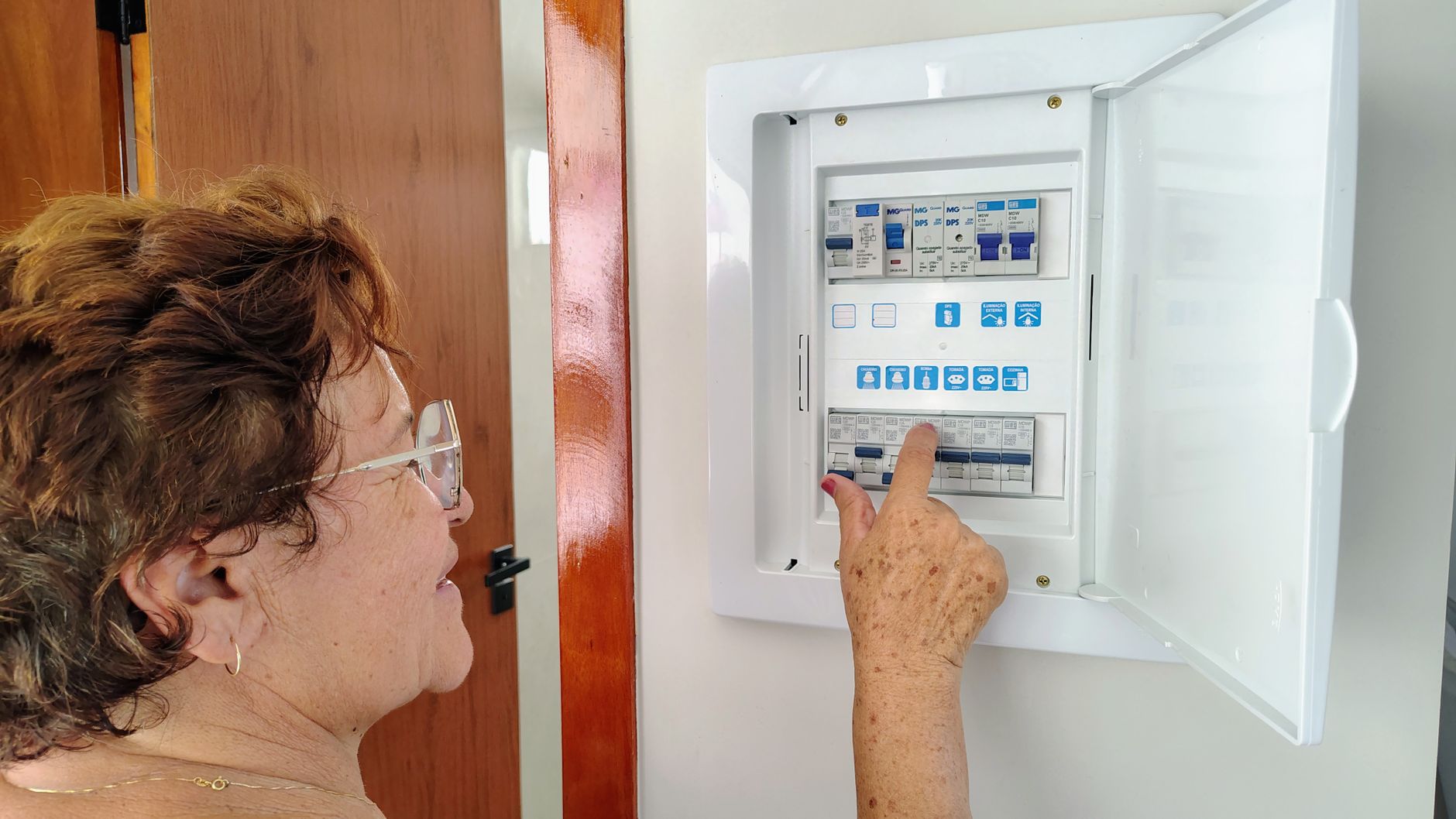
A breaker that trips once in a while is doing exactly what it's designed to do — protecting your home's wiring from damage or fire. But if your circuit breaker keeps tripping repeatedly, especially on the same circuit, that's a signal worth investigating rather than ignoring. The fix ranges from "unplug the space heater" to "call an electrician today," and knowing which category you're in starts with understanding why breakers trip in the first place.
The Three Reasons Breakers Trip
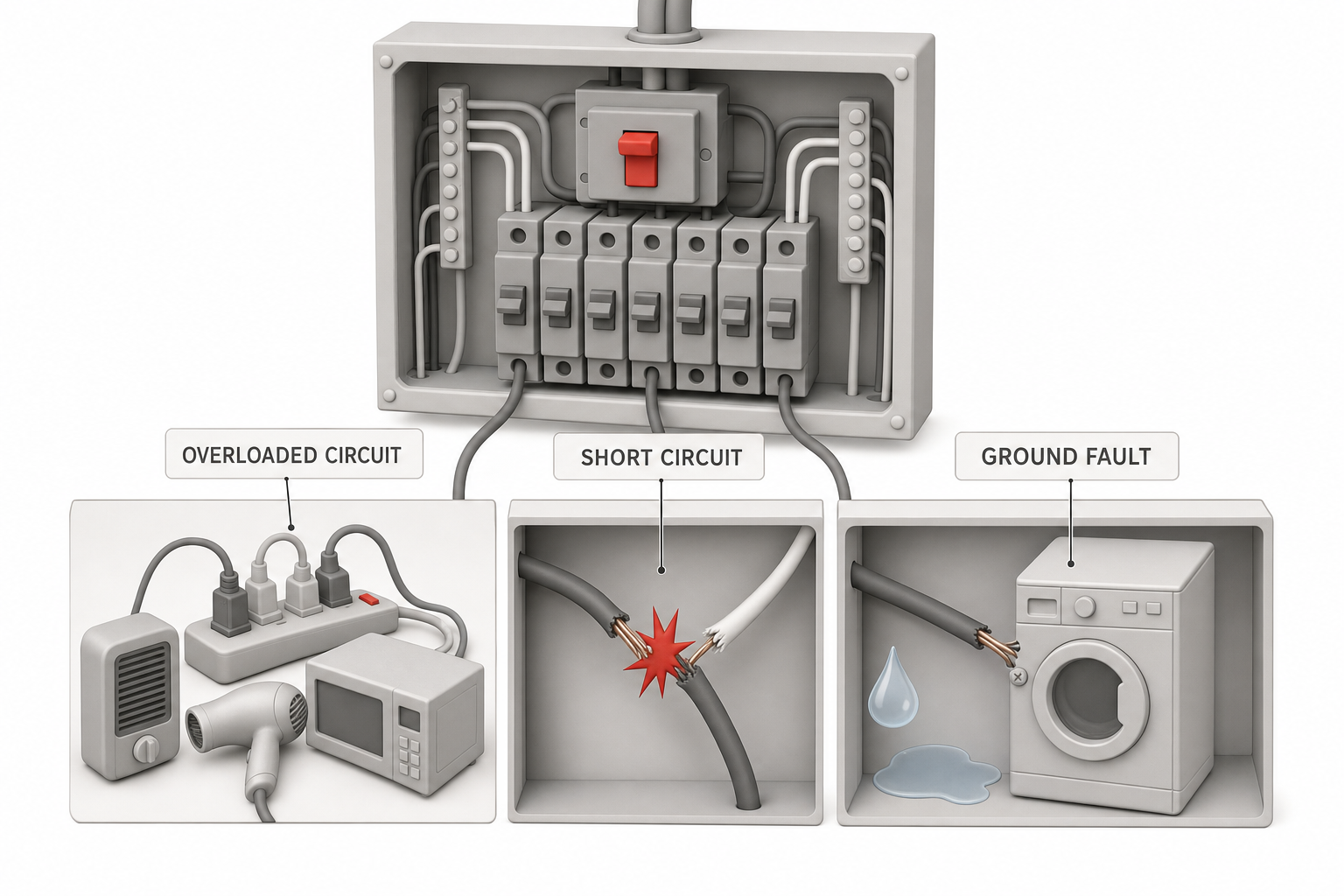
A circuit breaker trips for one of three basic reasons, and each one looks and behaves a little differently.
1. Overload — too much demand, not enough capacity
An overload happens when the total current drawn by everything plugged into a circuit exceeds what the breaker and wiring are rated to carry — typically 15 or 20 amps for a standard household branch circuit. Run a space heater, a microwave, and a hair dryer off the same kitchen or bedroom circuit, and you can easily exceed that limit.
What it feels like: The breaker trips only when several high-draw appliances are running at once, and the panel and outlets feel normal (not hot, no odd smell) beforehand. It usually takes a few minutes of combined load before the trip happens, not an instant snap.
Typical culprits: space heaters, hair dryers, window AC units, toaster ovens, vacuum cleaners, and older appliances with worn motors that draw more current than they used to.
2. Short Circuit — a wire-to-wire fault
A short circuit occurs when a hot (energized) wire touches a neutral wire or another hot wire, creating a near-zero-resistance path that lets current surge far beyond normal levels — often instantly and dramatically.
What it feels like: The breaker trips immediately and forcefully the moment you plug something in or flip a switch, sometimes with a visible spark, a popping sound, or a scorched smell at the outlet or panel. It can happen with nothing else running on the circuit at all.
Typical culprits: a damaged appliance cord with exposed wire, a lamp cord pinched under furniture, a wire nut that's come loose inside a junction box, or rodent damage to wiring in walls or attics.
3. Ground Fault — current escaping to a grounded surface
A ground fault happens when a hot wire contacts a grounded surface — a metal box, a grounded appliance chassis, or damp wood framing — instead of the neutral. This trips the breaker for a similar reason as a short, but the leak path is different, and it's often tied to moisture.
What it feels like: Trips are frequently linked to humidity, rain, or appliance use in wet locations — a washing machine, an outdoor outlet, a bathroom hair dryer, or a refrigerator with a frayed cord touching its metal casing. You may also notice a GFCI outlet tripping in tandem if one is present on the same circuit.
How to Tell Which One You Have
Work through this simple diagnostic before deciding whether it's a DIY job:
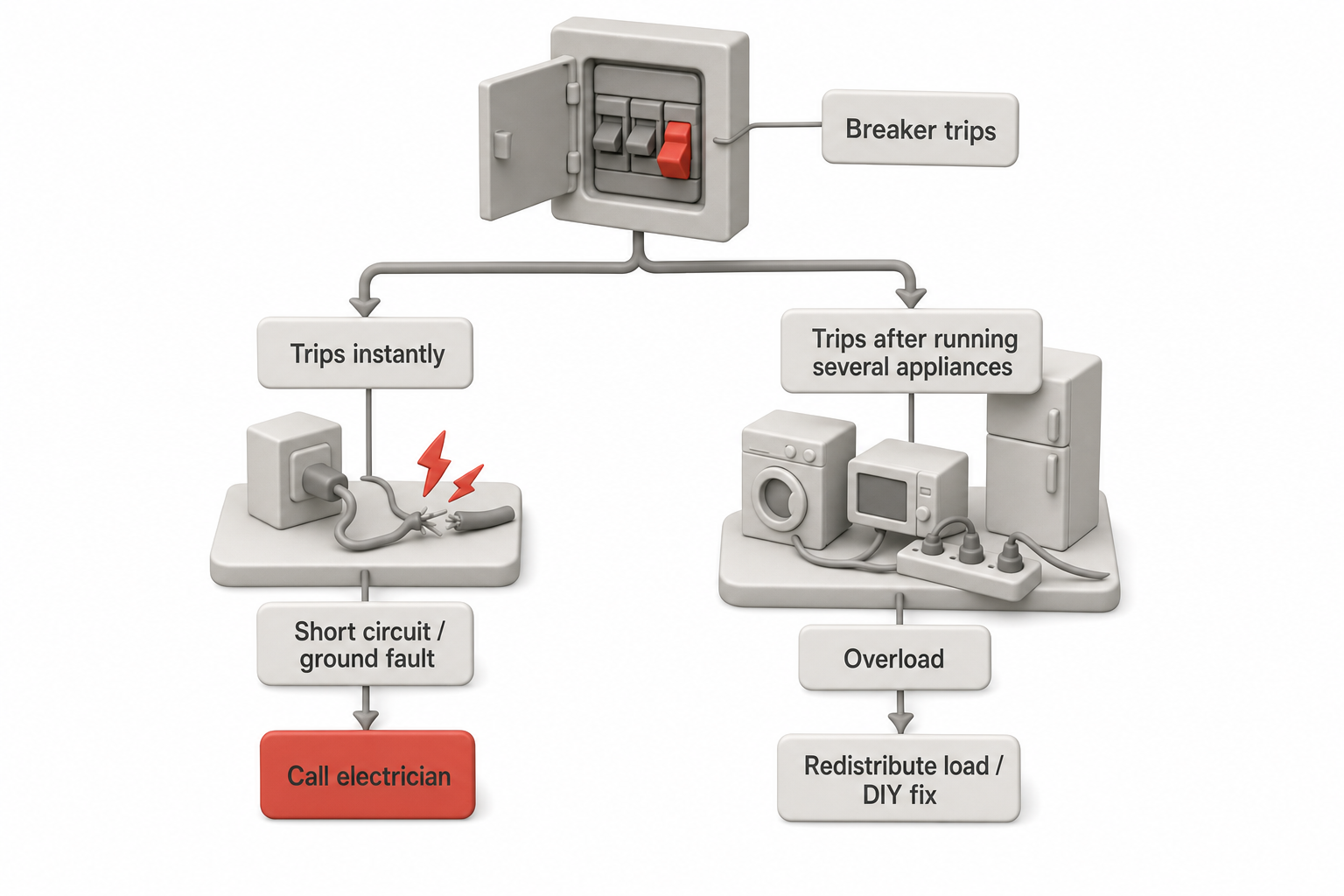
- Note exactly when it trips. Immediately on plugging something in (points to short or ground fault) versus only after running several devices for a while (points to overload).
- Check what's plugged into that circuit. If you can identify a specific appliance, unplug everything, reset the breaker, and plug items back in one at a time, waiting a minute between each. If the breaker trips the instant one particular item is plugged in, that appliance or its cord is the likely fault — stop using it.
- Inspect visible cords and outlets. Look for cracked or chewed cord insulation, discolored outlet faces, or a loose-fitting plug that wiggles in the outlet. Any of these point to a short or ground fault rather than an overload.
- Think about moisture. Did it start raining, did you just run a washing machine, or is the affected outlet in a bathroom, kitchen, garage, or outdoors? That pattern suggests a ground fault.
- Count the outlets on the circuit. If a single circuit feeds an entire kitchen counter run plus a refrigerator, or a bedroom plus a bathroom, it may simply be undersized for how you use it — a classic overload setup rather than a fault.
What You Can Safely Fix Yourself
- Redistribute the load. Move a space heater, window AC unit, or hair dryer to a different circuit, or simply avoid running high-draw appliances simultaneously on the same one.
- Replace a damaged appliance cord or the appliance itself if you've isolated the trip to one specific device with visibly frayed or cracked insulation.
- Reset a tripped GFCI outlet (the outlet with "test" and "reset" buttons) if a ground fault trip seems tied to a single wet-location outlet, and stop using that outlet in wet conditions until you've resolved the cause.
- Reset the breaker itself — flip it fully to "off" before flipping back to "on"; some breakers need this full cycle rather than a partial nudge back to the middle position.
What Calls for a Licensed Electrician
- The breaker trips immediately with nothing unusual plugged in, or trips repeatedly even after you've unplugged everything on the circuit — this points to a fault inside the wiring itself, not the devices attached to it.
- You see scorch marks, smell burning, or the breaker or outlet feels warm.
- The breaker won't reset at all, or trips again within seconds of resetting.
- You suspect the circuit is genuinely undersized for its intended use (for example, a kitchen with only one 15-amp circuit for several countertop appliances) and want a new dedicated circuit added.
- The panel itself is old, has a brand history of unreliable breakers, or you're not confident identifying its age and condition — a professional can assess whether the panel needs service beyond a single breaker.
FAQ
Why does my circuit breaker keep tripping even when nothing seems to be plugged in? This usually means the fault is inside the wiring or a fixture on that circuit — a loose connection, damaged insulation behind a wall, or a failing light fixture — rather than something you can unplug. It's a strong sign to call a licensed electrician for an inspection.
Is it safe to just keep resetting the breaker? Resetting once or twice to test is fine, but if it trips again quickly or repeatedly, stop resetting it. Repeated tripping means the breaker is doing its job protecting you from a real problem, and continuing to force it back on risks overheating the wiring.
Can a breaker itself go bad and trip for no reason? Yes, breakers can wear out over years of use and trip more easily than their rating suggests, or fail to reset properly. An electrician can test the breaker itself to confirm whether it needs replacing rather than the wiring.
What's the difference between a GFCI outlet tripping and a breaker tripping? A GFCI outlet protects a smaller, localized area (often one outlet or a short run) against ground faults and has its own reset button, while a breaker in the panel protects the entire circuit against overloads, shorts, and sometimes ground faults too, depending on the breaker type installed.
Should I upgrade my panel if breakers keep tripping across multiple circuits? Frequent trips on several different circuits can suggest your home's overall electrical capacity no longer matches your usage, particularly in older homes. This is a job for a licensed electrician to evaluate, not a DIY project.