
A dead outlet doesn't always mean a wiring fault. Before you assume the worst, a few minutes with the right tool can tell you whether the problem is the outlet itself, a tripped breaker, a bad connection, or something further down the circuit. This guide walks through how to test a wall outlet for power using two beginner-friendly tools: a plug-in outlet tester and a multimeter. Both are inexpensive, widely available, and don't require any electrical background to use correctly.
What You'll Need
- A plug-in outlet tester (a small three-prong device with indicator lights) — the fastest and safest option for beginners
- A digital multimeter set to AC voltage, if you want more detailed readings
- A flashlight, if the outlet is in a dim area
- Access to your home's electrical panel, in case you need to check or reset a breaker
Step 1: Rule Out the Obvious First
Before testing, check whether other outlets or lights on the same circuit are also out. Look at your electrical panel for a tripped breaker — it often sits in a middle position between "on" and "off" rather than fully flipped. If you find one, switch it fully off, then back on. If it trips again immediately, don't keep resetting it; that usually signals a short or overload that needs professional attention.
Also check for a tripped GFCI (Ground Fault Circuit Interrupter) outlet nearby. Many homes wire multiple outlets — especially in kitchens, bathrooms, garages, and outdoor areas — off a single GFCI, so a tripped GFCI outlet in one room can kill power to outlets in another. Press the "reset" button on any GFCI outlets you can find on the same wall or circuit.
Step 2: Test with a Plug-In Outlet Tester
This is the simplest and safest method for most homeowners, and it's the one we'd recommend starting with — see the recommendations below for a suitable tester.
- Push the tester firmly into the outlet until it's fully seated.
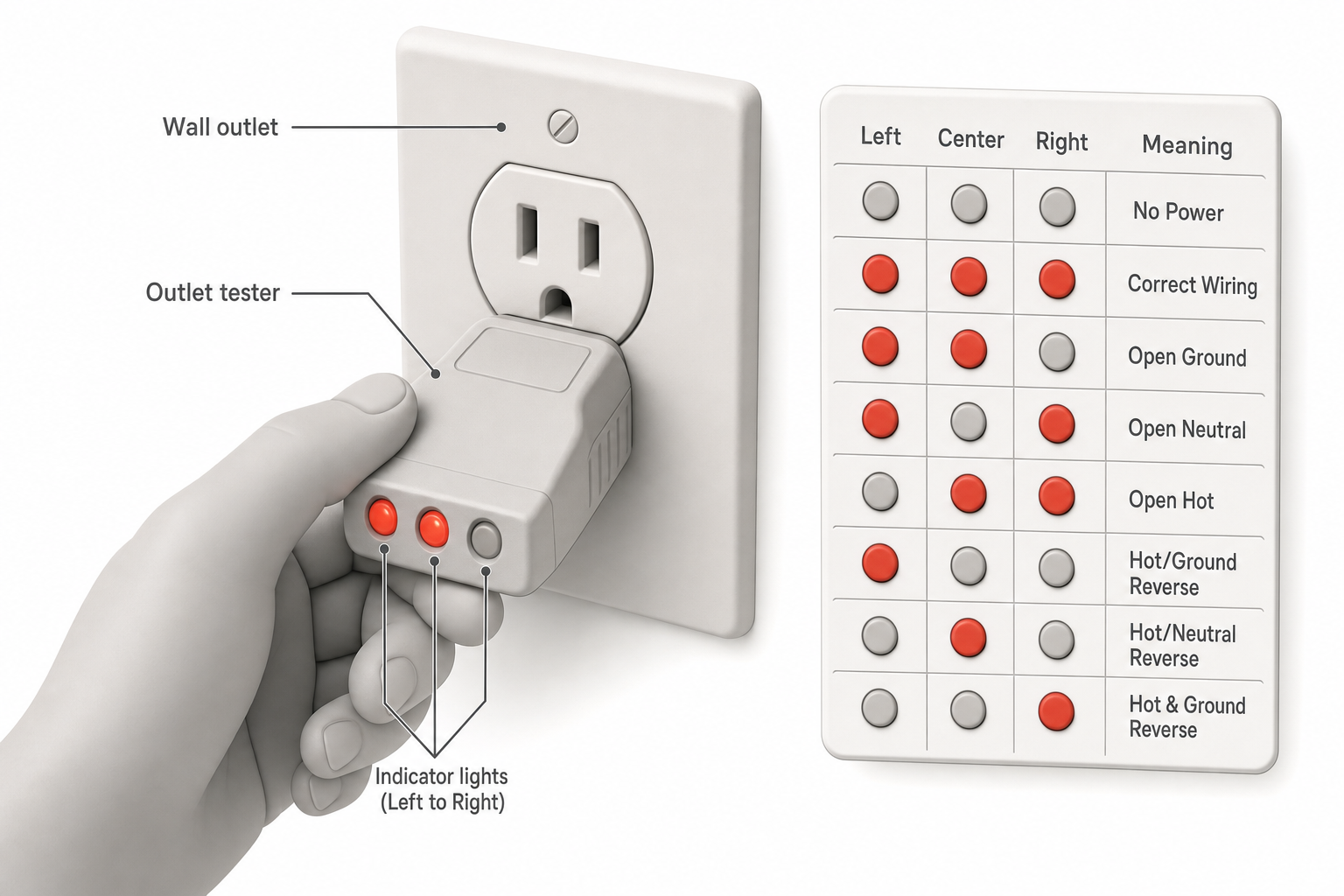
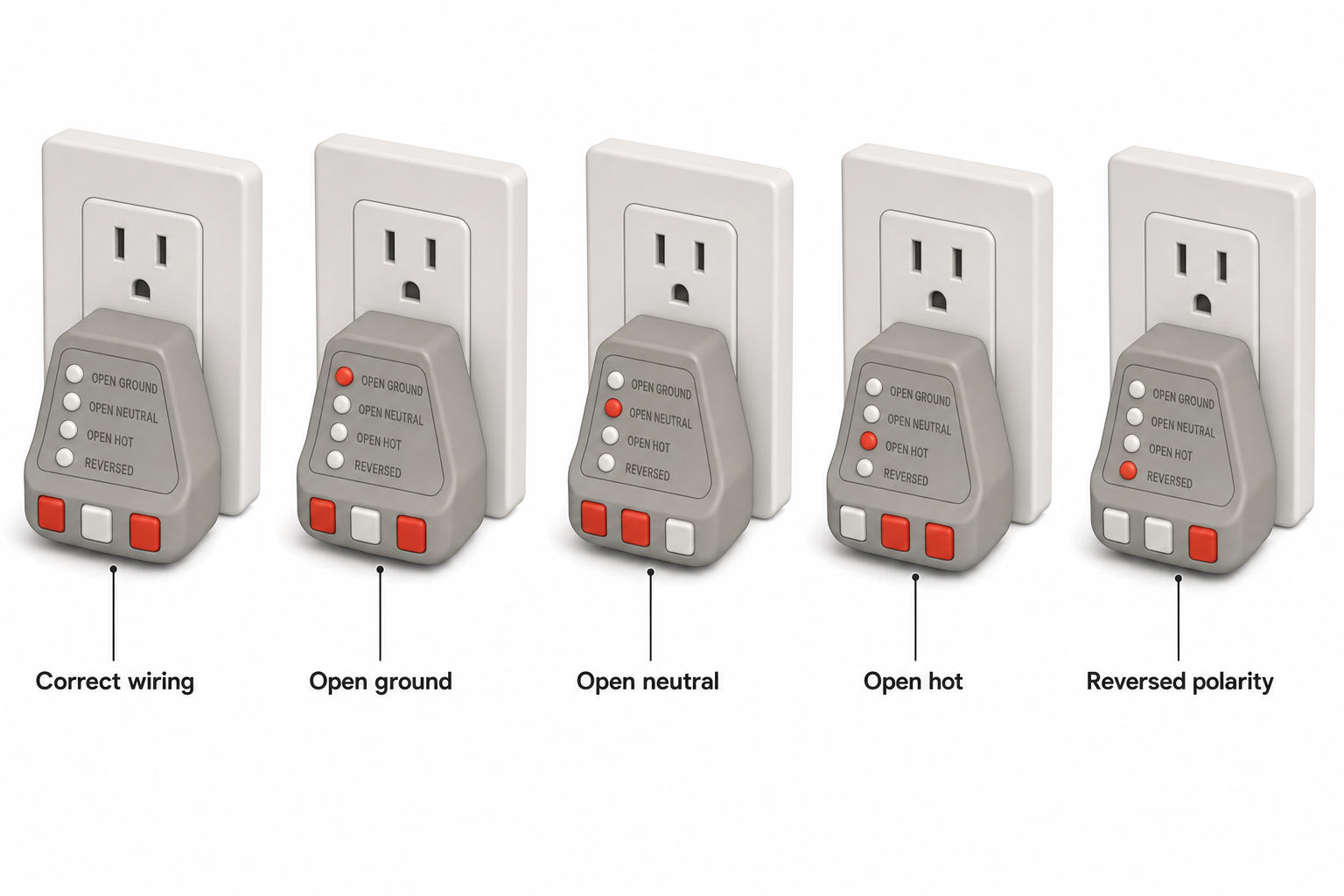
- Read the pattern of indicator lights. Most testers include a printed legend on the body showing what each combination means.
- A normal, correctly wired outlet typically lights up in the pattern labeled "correct" on the legend.
- Other common patterns indicate specific faults: an open ground, an open neutral, an open hot (no power), reversed polarity, or hot/ground reversed. Each of these points to a different underlying issue, from a loose wire to a wiring mistake made during installation.
If the tester shows no lights at all, the outlet likely has no power reaching it — move on to Step 3 to confirm with a multimeter, or check the breaker and GFCI again.
Step 3: Confirm with a Multimeter
A multimeter gives you an actual voltage reading rather than just a pass/fail pattern, which is useful if the outlet tester result seems inconsistent or if you want to double-check before calling a professional.
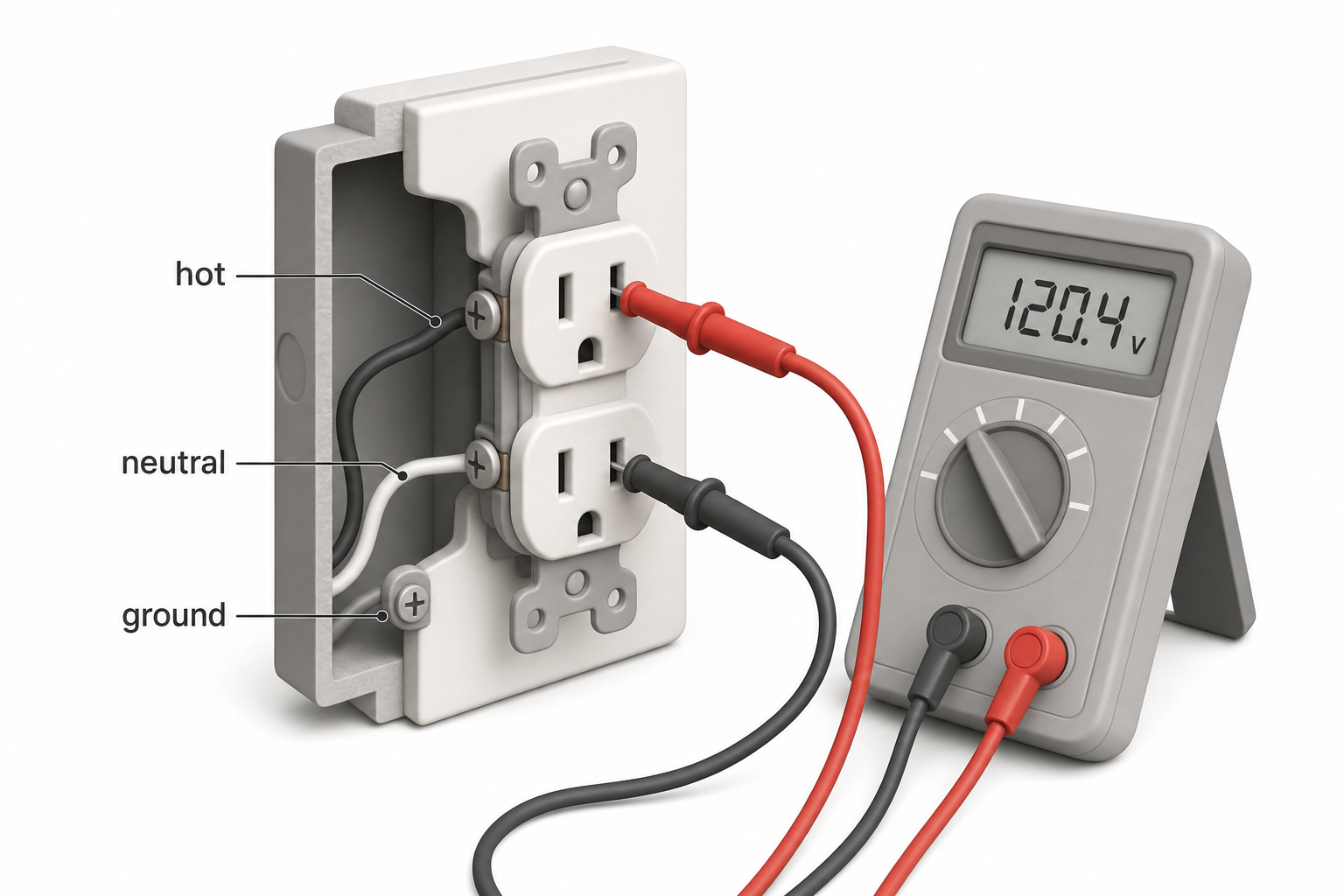
- Set the multimeter dial to AC voltage (look for a "V" with a wavy line, usually labeled ACV or V~). Choose a range above your expected voltage if the meter isn't auto-ranging — for example, a 200V range for a 120V outlet, or a 750V range for a 230–240V outlet.
- Insert the black probe into the shorter vertical slot on a standard North American outlet (the "hot" slot) — or, in regions with different plug standards, into the corresponding live terminal. Insert the red probe into the longer slot ("neutral").
- Read the display. In North America, a properly functioning outlet typically reads somewhere in the range of about 110–125V. In regions running 220–240V systems, expect a reading in that range instead.
- Next, test hot-to-ground: black probe in the hot slot, red probe in the round grounding hole. You should get a similar reading to the hot-neutral test. A significant difference between the two readings can indicate a grounding problem.
- Finally, test neutral-to-ground with the probes in those two slots. This should read close to 0V. A reading of several volts or more can suggest a loose or improperly wired neutral connection, which is worth having an electrician look at.
Step 4: Interpreting What You Find
- No voltage at all, and the tester shows no lights: Likely a tripped breaker, a tripped GFCI upstream, a loose wire connection at the outlet or a junction box, or a failed outlet itself.
- Voltage present but inconsistent or flickering: Often points to a loose wire connection (a common failure point at outlet terminals over time) rather than a panel issue.
- Reversed polarity or open ground on the tester: This is a wiring configuration issue rather than a total power loss, and it's worth having a professional correct it, since it can affect the safe operation of anything plugged in, particularly appliances relying on proper grounding.
- Neutral-to-ground voltage that's higher than expected: Can indicate a shared neutral issue or loose neutral connection elsewhere on the circuit — this is a job for a licensed electrician, since neutral problems can be harder to trace and can affect multiple outlets.
If your testing shows the outlet has no power and resetting breakers and GFCIs hasn't helped, the next step is usually to check other outlets on the same circuit to see how widespread the issue is, then consider whether it's time to call a licensed electrician — particularly if you're not comfortable opening the outlet box to check wire connections.
When to Call a Professional
FAQ
Can I test an outlet without any tools? Not safely or reliably. Plugging in a lamp only tells you whether the outlet has power, not why it doesn't if it fails — and it won't reveal wiring problems like reversed polarity or an open ground, which can exist even when a lamp turns on.
Why does my outlet tester show a fault but the lamp I plugged in still works? Many wiring faults, like an open ground or reversed polarity, don't prevent basic appliances from running because they don't rely on the ground connection. The outlet can still be unsafe or improperly wired even though it appears to function normally.
Is it normal for outlets to read slightly above or below the standard voltage? Small variations are common and generally not a concern; utility voltage naturally fluctuates somewhat throughout the day. A reading noticeably outside your region's typical range, or one that changes dramatically while you watch, is worth mentioning to an electrician.
What's the difference between an outlet tester and a multimeter for this job? An outlet tester quickly diagnoses common wiring patterns using indicator lights and requires no interpretation of numbers, making it ideal for beginners. A multimeter gives precise voltage readings and can catch subtler issues, like a slightly elevated neutral-to-ground voltage, but requires understanding what the numbers mean.
Should I test every outlet in my house as routine maintenance? It's not strictly necessary, but testing outlets in kitchens, bathrooms, garages, and outdoor areas periodically is reasonable, since these often have GFCI protection and see more moisture exposure, which can affect connections over time.